
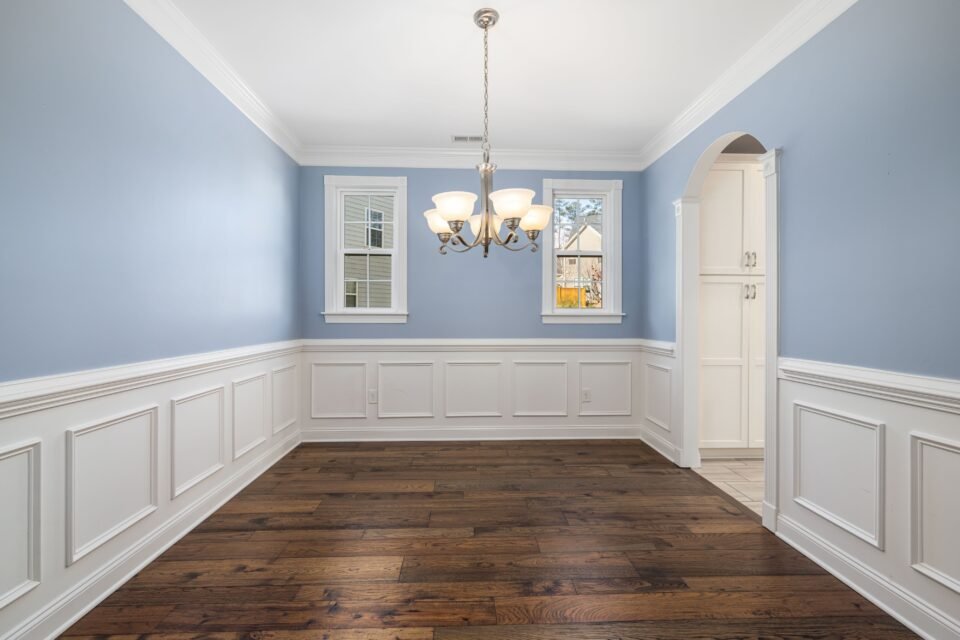
Wainscoting is decorative wall paneling that covers the lower part of a wall, usually from the floor up to about one-third of the wall’s height. It protects the wall, adds texture and gives a plain room a finished, architectural look. what is wainscoting If you have ever seen a painted panel treatment below a chair rail in a dining room, hallway or bedroom, you have seen wainscoting.
This guide explains what wainscoting is, how it differs from similar terms, which styles and materials exist, how high to make it, what it costs, where it works (and where it does not), and how to install it step by step. what is wainscoting It also covers the awkward real-world cases most guides skip: uneven walls, outlets, corners, stairs and rentals.
What Is Wainscoting?
Wainscoting is a wall treatment made of panels, boards or trim that cover the lower section of an interior wall. It typically has three parts:
- Baseboard at the bottom, where the wall meets the floor.
- Panel field in the middle: flat panels, beadboard planks, raised panels or trim shapes.
- Cap or chair rail on top, which finishes the edge and gives the treatment a clean top line.
The panel field is built from stiles (vertical boards) and rails (horizontal boards). Panels or trim sit between them.
What it looks like
Picture a wall divided into two zones. The bottom third has a repeated pattern of vertical planks, rectangles or squares, what is wainscoting usually painted one color. The upper two-thirds is plain painted wall, wallpaper or a contrasting shade. A horizontal cap runs along the join.
Wainscoting vs paneling vs chair rail

These terms are often mixed up, so here is the difference:
| Term | What it means | Covers |
|---|---|---|
| Wainscoting | Paneling on the lower part of a wall | Lower third to lower half |
| Wall paneling | Paneling in general, often full height | Partial or entire wall |
| Chair rail | A single horizontal molding | Just a line, no panels |
| Wainscot (noun) | The same thing as wainscoting; also used for the paneled area itself | Lower wall |
In short, wainscoting is one kind of wall paneling. A chair rail is one component of it, and it can also be used alone.
A Brief History of Wainscoting

The word wainscot is generally traced to Middle Dutch and Low German roots, and it originally referred to a high-quality kind of imported oak board. what is wainscoting Over time the term shifted from the timber itself to the paneling made from it.
The commonly given practical explanation is that wood paneling on lower walls helped protect interior surfaces from damp and wear in cold, drafty buildings, especially in northern Europe. Panels also made rooms feel warmer. Later, paneling became a status feature in wealthy homes, what is wainscoting with carved and raised panels in fine timber. In the American colonial period, simpler paneled and painted styles became common, and Victorian homes popularized beadboard as milled boards became cheaper.
For formal citations on the history, consult a reference such as an encyclopedia entry on wainscot or an architectural conservation source, because exact dates and origins vary by region.
What Are the Main Types of Wainscoting?

The style you choose affects the look, the cost and how hard the job is. Here are the five most common styles.
Beadboard
Narrow vertical planks with a small groove, or “bead,” between each one. It has a cottage, farmhouse or country feel. what is wainscoting It comes in sheets (fast to install) or individual tongue-and-groove planks (more authentic, more work). It suits kitchens, laundry rooms, mudrooms and kids’ rooms.
Raised panel
Rectangular panels with a bevelled, three-dimensional edge set inside a frame. It is the most traditional and formal style, associated with dining rooms, libraries and entryways. It is also the most expensive and complex to build.
Flat panel (Shaker)
Simple recessed rectangles with clean edges. It works in both modern and traditional rooms and is easy to paint and clean. It is one of the most popular choices today.
Board and batten
Wide vertical boards with narrow strips (battens) covering the seams, or just evenly spaced vertical strips on a flat backer. what is wainscoting It is a bold, graphic look that is straightforward to build yourself. Because it is often taller than standard wainscoting, it sometimes shades into full wall paneling.
Picture-frame molding
Thin molding strips arranged as rectangles directly on the wall, with no panel behind them. It is the cheapest and easiest way to get a paneled look, and it is the most common beginner DIY project. The wall surface inside each frame can be painted the same color or a contrasting one.
Quick style comparison
| Style | Look | Difficulty | Relative cost | Best for |
|---|---|---|---|---|
| Beadboard | Casual, cottage | Low to medium | Low | Kitchens, laundry, kids’ rooms |
| Raised panel | Formal, traditional | High | High | Dining rooms, studies |
| Flat / Shaker | Clean, versatile | Medium | Medium | Almost any room |
| Board and batten | Bold, modern farmhouse | Low to medium | Low to medium | Hallways, bedrooms, entryways |
| Picture frame | Light, elegant | Low | Low | Beginners, rentals (with permission), bedrooms |
What Materials Are Used for Wainscoting?
Material choice matters more than most guides admit, because it decides how the wainscoting handles moisture, impact and painting.
| Material | Strengths | Weaknesses | Moisture suitability |
|---|---|---|---|
| Solid wood (pine, oak, poplar) | Authentic, repairable, can be stained | Expensive; moves with humidity; can warp or split | Fair if well sealed |
| MDF | Smooth, paints beautifully, affordable, consistent | Swells if water reaches cut edges; heavy; dust when cut | Poor in wet areas unless fully sealed |
| Plywood | Strong, light, good for flat panels and board-and-batten | Visible edge plies need filling; quality varies | Fair to good (exterior-grade or sealed) |
| PVC / WPC | Waterproof, rot-resistant, low maintenance | Can look plastic, may dent or yellow with some finishes, less rigid | Excellent |
| Beadboard sheets (MDF or plywood) | Fast installation | Seams show if poorly finished | Depends on core material |
Which is best? For a dry living room, hallway or bedroom, MDF or plywood gives a smooth painted finish at a reasonable price. what is wainscoting Use solid wood where you want stain or a heritage look. For bathrooms with showers, and for any area that gets splashed, PVC or WPC is the safest option. If you use MDF near moisture, prime and paint every face and every cut edge, caulk all joints and ventilate well.
How High Should Wainscoting Be?
The one-third rule
The classic guideline is to make wainscoting about one-third of the wall height. On an 8 ft (about 2.4 m) wall, that is roughly 32 inches. what is wainscoting The rule works because it avoids splitting the wall into two equal halves, which can look static.
Ceiling height, furniture and proportions
The rule is a starting point, not a law. Consider these factors:
- Ceiling height. Taller ceilings can carry taller wainscoting without feeling heavy.
- Furniture. Chair backs, sofas, headboards and sideboards should not collide awkwardly with the top rail. A chair rail around 32–36 inches high helps protect dining room walls from chair backs.
- Windows and outlets. Try to align the top rail with the window sill or stool when possible.
- Room size. In small rooms, lower wainscoting feels lighter. Higher, two-thirds-height treatments can feel dramatic and cozy.
Typical height ranges (guide only)
| Ceiling height | Common wainscoting height | Notes |
|---|---|---|
| 8 ft / 2.4 m | 32–36 in (80–90 cm) | Standard for most homes |
| 9 ft / 2.7 m | 36–42 in (90–105 cm) | Slightly more presence |
| 10 ft / 3 m | 42–54 in (105–135 cm) | Works well with taller panels |
| Any height | Two-thirds or full height | Dramatic; usually called wall paneling |
Before you commit, cut a strip of painter’s tape or cardboard to your intended height and hold it against the wall. what is wainscoting View it from the doorway and from where you sit. Adjust until it feels right.
Where Should You Use Wainscoting?
Living room. Flat panel or picture-frame styles add structure without overpowering furniture. Painting the lower wall a deeper shade than the upper creates a grounded, cozy look.
Dining room. The traditional home for wainscoting. It protects walls from chair backs and adds formality. Raised or Shaker panels suit this room well.
Hallway and entryway. High-traffic areas benefit from the durability of painted panels. Scuffs wipe off easily if you use a satin or semi-gloss finish.
Bedroom. Board and batten or picture-frame molding behind the bed can act as a feature wall, and a taller version can replace a headboard.
Bathroom and kitchen cautions. Wainscoting can work in bathrooms and kitchens if the material and finish are right. Use PVC or WPC in splash zones. Keep MDF away from tubs and showers, and make sure there is ventilation. Seal every edge and joint, and leave a small, caulked gap at the floor so water cannot wick up from below.
How Much Does Wainscoting Cost?
Cost depends on four things: materials, labor, wall area and complexity. what is wainscoting Prices change by country and by year, so treat any published price list, including the examples here, as a starting point and get local quotes.
DIY vs professional
Doing it yourself saves labor, which is often the largest share of the bill. A professional charges more but brings speed, what is wainscoting accurate cuts and experience with problem walls. Raised panel and custom-milled work is usually best left to a carpenter.
Material, labor and room-size factors
Use this simple method to estimate your own cost:
- Measure the linear length of every wall you will cover.
- Subtract openings such as doors (use their width).
- Multiply by the height to get square footage (or square meters).
- Add 10–15% for waste and angled cuts.
- Multiply by your local price per square foot or meter, then add finishing supplies and labor if hiring.
Worked example (illustrative numbers only):
A 12 ft × 14 ft room has a perimeter of 52 ft. Subtract one 3 ft door opening and you have 49 linear feet. At a height of 3 ft (36 in), that is 147 sq ft. Add 10% waste: about 162 sq ft.
If your local material price (panels, trim, adhesive, caulk and paint combined) were, for example, 6 currency units per sq ft, the materials would be about 972. what is wainscoting If a contractor charged 8 units per sq ft for labor, labor would add about 1,296. Replace these example prices with real local quotes before budgeting.
What pushes cost up:
- Raised panels and custom millwork
- Solid hardwood instead of MDF or plywood
- Taller wainscoting
- Many corners, windows and outlets
- Staircases and angled walls
- Repairing or leveling the wall first
What keeps cost down:
- Picture-frame molding or board and batten
- Pre-primed MDF
- Painting everything the same color
- Doing the painting yourself even if you hire for the carpentry
How to Install Wainscoting (Step by Step)
This walkthrough uses picture-frame or flat-panel style on a standard drywall wall. Adjust for your chosen style.
Tools and materials
- Tape measure, pencil and 4 ft level (or laser level)
- Stud finder
- Miter saw or miter box with fine-tooth saw
- Brad nailer (or hammer and finish nails)
- Construction adhesive
- Panels, rails, stiles, cap and baseboard
- Wood filler, paintable caulk, sandpaper (120–220 grit)
- Primer and paint, brushes or a small roller
- Safety glasses, dust mask, hearing protection
Step 1: Measure and plan
Sketch each wall. Decide the final height, then plan the layout so that stiles and panels are evenly spaced and nothing ends in a thin sliver. what is wainscoting Mark window and door positions. A scale drawing prevents costly cutting errors.
Step 2: Prepare the wall
Remove old baseboards carefully if you are replacing them. Fill holes, scrape loose paint and wipe away dust. Locate and mark the studs, what is wainscoting which are commonly spaced 16 inches apart in many countries but not everywhere. Check for plumbness and flatness.
Step 3: Mark your lines
Draw a level line at the top-rail height, all the way around the room. Do not trust the floor to be level. Measure from the floor in several places and use your level to make a true line.
Step 4: Cut your pieces
Cut the rails and stiles to length. Use mitered cuts at inside corners if the molding profile requires it, or butt joints for flat boards. Dry-fit the pieces on the floor before attaching.
Step 5: Attach
Apply a bead of construction adhesive to the back of each piece, press it into place and secure it with brad nails into studs where possible. what is wainscoting Install the baseboard and bottom rail first, then stiles, then the top rail and cap. Check level after every few pieces.
Step 6: Fill, caulk and sand
Fill nail holes with wood filler, sand smooth, and caulk every seam where wainscoting meets the wall and where pieces meet each other. Caulking is what makes the finish look professional.
Step 7: Prime and paint
Prime all surfaces, especially cut edges of MDF. Apply two coats of durable paint, ideally satin or semi-gloss, which are easier to clean. Let each coat dry fully.
Handling difficult situations
- Uneven walls. Wavy or bowed walls leave gaps behind rails. Use shims for larger gaps, and flexible paintable caulk for small ones. Scribing, which means trimming the back edge to match the wall, helps in older homes.
- Outlets and switches. Turn off power at the breaker first. Cut a clean opening in the panel. Where the panel adds thickness, use box extenders so the device remains flush and code-compliant. If you are not comfortable with electrical work, hire an electrician.
- Corners. Inside corners can be butted or mitered. Outside corners are best mitered or finished with a corner trim. Test on scrap first.
- Baseboards. Either keep the existing baseboard and build above it, or replace it so the new panels sit flush with a taller baseboard.
- Stairs. The wainscoting follows the angle of the staircase. Mark the angle with a sliding bevel and cut each piece to match, keeping the top rail parallel to the stair slope.
- Rentals. Check your lease first. Paint-on options or lightweight trim that attaches with removable fixings may be allowed, but permanent nailing and adhesive often are not. A faux version, such as painted rectangles with removable molding, can give a similar look with less risk.
Faux Wainscoting: A Budget Alternative
Faux wainscoting creates the visual effect without full panels. The most common method is a chair rail with a contrasting paint color below it. Another is adding molding rectangles directly on the wall. what is wainscoting It costs less and installs faster, but it provides less physical protection and less texture than real panels. It is a good way to test the look before committing to a bigger project.
Pros and Cons of Wainscoting
Pros
- Adds character and a sense of craftsmanship
- Helps protect the lower wall from scuffs, bumps and furniture
- Works with many styles, from traditional to modern
- Can be painted any color and repainted later
- Easy to scale: from a simple trim project to custom millwork
Cons
- Costs more than paint alone
- Takes time and skill to install well
- Some materials, especially MDF, are vulnerable to moisture
- Can make a very small, dark room feel closed in if the color is heavy
- Hard to remove cleanly once glued and nailed
Some sellers claim that wainscoting improves acoustics or raises resale value. Results depend on the room, the materials and the market, what is wainscoting so treat such claims cautiously and ask a local real estate professional about your area.
Cleaning, Maintenance and Repairs
- Dust with a soft cloth or vacuum brush attachment every few weeks. Beadboard grooves and raised panel edges collect dust.
- Wipe with a damp cloth and mild soap. Avoid soaking MDF.
- Scuffs usually come off with a melamine sponge used gently or a touch-up of paint.
- Dents and holes can be filled with wood filler, sanded and repainted.
- Cracked caulk should be removed and replaced, since gaps let in moisture and dust.
- Humidity. Keep indoor humidity steady. Wood and MDF move with big swings in moisture, which can crack paint at the joints.
- Repainting. Lightly sand, clean and prime if needed before applying a new coat.
Common Wainscoting Mistakes to Avoid
- Guessing the height instead of testing it with tape first.
- Assuming the floor is level and measuring from it alone.
- Skipping the stud finder, which leads to weak, wobbly panels.
- Forgetting expansion and wall flaws, leaving visible gaps.
- Using MDF in wet areas without sealing every edge.
- Not priming cut edges, which causes swelling and rough paint.
- Ignoring outlets until after the panels are up.
- Skipping caulk, which is the step that hides joints.
- Mixing too many styles in one room.
- Choosing a color first, instead of choosing the style, height and material first.
Frequently Asked Questions
What is wainscoting in simple words?
It is decorative paneling on the lower part of an interior wall, usually about one-third of the way up, finished with a cap or chair rail on top.
Is wainscoting outdated?
No. Traditional raised panels may read as classic or formal, but Shaker, board and batten and picture-frame styles are widely used in modern and transitional homes. Style depends on proportions, color and detailing more than on the wainscoting itself.
Does wainscoting make a room look smaller?
It can add visual weight, especially in dark colors or in a small, windowless room. Light colors, lower heights and good lighting reduce that effect. In many rooms it adds depth and makes the space feel more intentional rather than smaller.
Can wainscoting be used in bathrooms?
Yes, with the right material. PVC or WPC is the safest choice, especially near showers and tubs. If you use MDF or wood, seal all surfaces, use moisture-resistant paint, caulk well and ventilate the room.
Is wainscoting expensive?
It ranges widely. Picture-frame molding and board and batten are among the most economical, while custom raised panels in hardwood are among the most expensive. Use the area-based estimate above and compare local quotes.
Can I install wainscoting myself?
Often yes, especially picture-frame, board-and-batten or sheet beadboard styles. You need basic carpentry skills, accurate measuring and patience. Hire a professional for custom raised panels, complicated stairs or electrical changes.
Final Thoughts
Wainscoting is more than decoration. Done well, it gives walls structure, protection and personality. The best results come from choosing a style that suits your home, a material that suits the room’s moisture level, a height that suits your ceiling and furniture, and a finish that is properly primed, caulked and painted.
Start small if you are unsure. A picture-frame or faux treatment in one room is a good test. If you love it, you can move on to fuller panels elsewhere. Whatever you choose, measure carefully, plan the layout and take your time with the details, because that is where wainscoting looks either ordinary or excellent.