
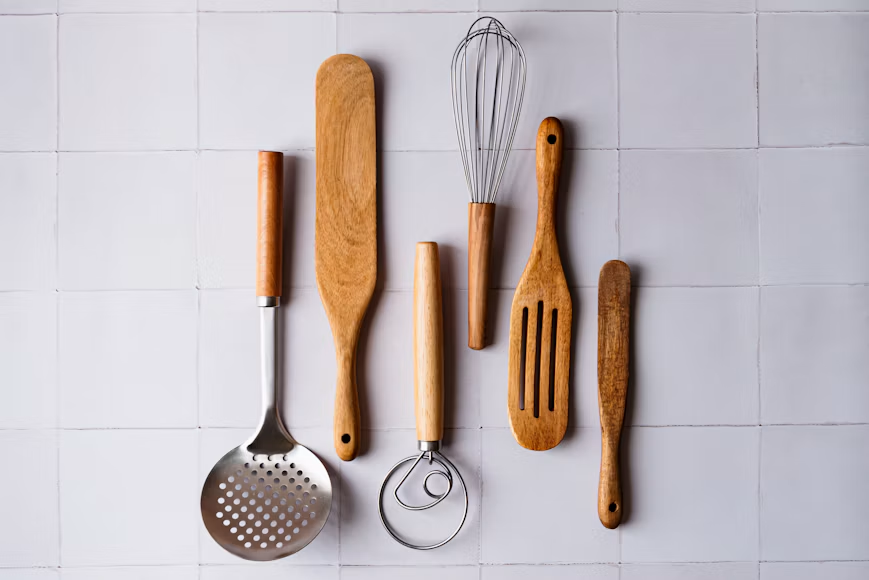
Kitchen utensils are the handheld tools you use to prepare, cook, measure, mix, and serve food. Common examples include spatulas, wooden spoons, whisks, tongs, peelers, ladles, and measuring cups. Each tool has a job, and the right cooking utensils make everyday meals easier, faster, and less messy.
Still, no kitchen needs a huge collection. Beginners often ask which cooking tools are essential, which materials suit their pans, and whether a kitchen utensil set is worth the money. This guide explains the main types of kitchen utensils and their uses, compares materials, covers cleaning, and shares buying tips so you can build a useful collection without filling your drawers with tools you never touch.
What Are Kitchen Utensils?
Kitchen utensils are handheld tools for food preparation, cooking, baking, and serving. They stir ingredients, turn food, measure quantities, strain liquids, and move meals from pots to plates. A spatula flips or scrapes, a whisk blends and adds air, a vegetable peeler removes skins, and a soup ladle serves broth.
The best utensils depend on what you cook, how often you cook, and which pots, pans, and appliances you own.
Kitchen Utensils vs. Cookware and Appliances
These terms describe different categories of equipment:
- Kitchen utensils: Handheld tools such as spoons, tongs, whisks, spatulas, and peelers.
- Cookware: Pans, saucepans, stockpots, and Dutch ovens used to cook food.
- Appliances: Blenders, food processors, stand mixers, and microwaves.
- Eating utensils: Tools for eating, such as a knife and fork set or teaspoons.
Some items cross categories. A serving spoon is a kitchen utensil, while a teaspoon may be used for eating or measuring. Overall, kitchen tools and equipment cover everything from small hand tools to large appliances.
Why the Right Tools Matter
Good utensils feel comfortable, suit their tasks, and clean easily. A sturdy turner makes flipping pancakes simple, while a flexible silicone spatula scrapes every bit of batter from a bowl. Utensil choice also protects your pans. Metal can scratch some nonstick coatings, so a compatible silicone or manufacturer-approved tool is often safer. You do not need the most expensive tools to create a practical kitchen.
Essential Kitchen Utensils and Their Uses
If you are setting up a first kitchen, start with versatile tools that handle several tasks. Add specialty items later.
Spoons, Spatulas, and Turners
These are among the most useful cooking utensils:
- Wooden spoons for cooking: Stir soups, sauces, and stews. Small wooden spoons suit jars, spice mixes, and tasting.
- Slotted spoon: Lifts food while liquid drains away.
- Spatula: Scrapes bowls, spreads mixtures, and folds batter. The best spatula depends on its shape and construction.
- Silicone spatula: Flexible and ideal for scraping, mixing, and many nonstick tasks. A mini spatula reaches into small jars.
- Fish spatula: A thin, flexible turner that slides under delicate fillets and eggs.
- Wok spatula: A curved edge fits the wok’s sides for stir-frying.
- Icing spatula: Spreads frosting smoothly across cakes.
- Baking spatula: Folds batter and scrapes bowls without leaving waste.
- Spoon, silicone spoon: Useful for stirring and serving where a flexible head helps.
A complete spatula set often includes several shapes, which is handy if you cook and bake often. A flexible tool is especially helpful for baking, while a sturdy turner is better on the stovetop.
Whisks, Ladles, and Serving Tools
These tools help with mixing and serving:
- Whisks: Blend eggs, dressings, and sauces. A flat whisk suits shallow pans and gravies, a mini whisk or small whisk handles small bowls, and a dough whisk mixes thick bread dough. A silicone whisk protects nonstick surfaces.
- Soup ladle: Scoops soups, stews, and gravy. A ladle spoon with a long handle keeps your hand away from steam.
- Serving spoons: Move vegetables, rice, and sides to plates. Serving spoons sets keep matching sizes together, and stainless steel serving spoons last through years of use.
Tongs for Every Task
Tongs give you a secure grip on hot food. Cooking tongs turn meat and vegetables, serving tongs move food at the table, and salad tongs toss greens. Pasta tongs grab noodles, food tongs handle small items, and silicone tongs protect nonstick cookware. Metal tongs offer a strong grip for grilling, while bamboo tongs are gentle on delicate foods. Pick a size that fits your cookware and a locking mechanism that works smoothly.
Prep Tools: Mashers, Strainers, and Measures
- Potato masher: Crushes potatoes and soft vegetables. The best potato masher has a sturdy handle and a head that reaches the pan’s corners.
- Meat masher: Breaks up ground meat as it browns.
- Colander strainer: Drains pasta and rinsed produce. A stainless steel colander is durable and easy to clean.
- Best instant read thermometer: Checks food temperature quickly. It is a measuring instrument rather than a stirring tool, but it is a smart food safety purchase.
Handle peelers and graters carefully because their blades are sharp. Clean them after use and store them safely.
Different Types of Kitchen Utensils

Grouping tools by job makes it easier to decide what belongs in your kitchen.
Food preparation tools: Peelers, graters, strainers, shears, measuring cups, and mixing bowls get ingredients ready. A cutting board and knife are essential too, though they are often treated as a separate category.
Cooking and stirring tools: Spoons, turners, spatulas, tongs, and ladles work during heating. Choose tools that match your pans and food. Check the manufacturer’s temperature limit instead of assuming every plastic or silicone tool handles high heat.
Baking and measuring tools: Measuring cups and spoons, whisks, spatulas, rolling pins, and pastry brushes support accurate baking. Occasional bakers may only need a measuring set and a mixing bowl.
Serving tools: Serving spoons, salad servers, pasta servers, and ladles move food to plates. Start with the dishes you serve most.
Which Kitchen Utensil Materials Are Best?
Kitchen utensils come in wood, bamboo, silicone, stainless steel, nylon, and more. No material is ideal for every job, so match the material to the task, the temperature rating, and your cookware.
| Material | Best for | Key benefit | Limitation |
| Wood | Stirring and general cooking | Comfortable grip, gentle on pans | Needs careful drying |
| Bamboo | Lightweight stirring and serving | Light and easy to handle | Durability varies |
| Silicone | Scraping, mixing, nonstick tasks | Flexible reach | Heat limit depends on product |
| Stainless steel | Whisking, straining, serving | Durable and easy to clean | Can scratch nonstick |
| Nylon | Everyday cooking | Light and affordable | May warp if overheated |
Wooden and Bamboo Utensils

Wooden cooking utensils are popular for stirring because they feel good in the hand and are gentle on cookware. The best wooden cooking utensils have a smooth finish and sturdy construction. Bamboo cooking utensils are a lightweight alternative, though durability depends on the finish. Hand-wash wooden kitchen utensils, avoid soaking, and dry them fully. Replace any tool with deep cracks or splinters.
Silicone Utensils
Silicone utensils are flexible and handy for scraping and folding. The best silicone cooking utensils have a clear temperature rating and solid construction. A silicone kitchen utensils set often includes a spatula, spoon, ladle, whisk, and tongs. Silicone spatula sets suit bakers, and a silicone utensil set matches well with nonstick pans. Some tools have metal cores or mixed-material handles, so read the full specification before using one near high heat.
Stainless Steel Utensils

Stainless steel utensils are durable and easy to clean. Stainless steel cooking utensils suit whisking, straining, and serving, and a stainless steel colander drains pasta reliably. Metal can scratch some nonstick surfaces, so check your cookware’s guidance first. Stainless handles may also heat up near a flame.
Nylon and Other Materials

Nylon tools are light and often inexpensive, but not all nylon tolerates the same heat. Inspect them for warping and melting, and replace damaged ones.
Finishes and Style
Material is not the only choice. Many people also pick a finish to match their kitchen. Copper kitchen accessories and gold kitchen accessories add warmth, while black kitchen accessories look sleek. Wooden kitchen accessories bring a natural feel. Check that decorative coatings are rated for food contact and that the tool still performs its job well.
How to Choose the Right Kitchen Utensils
Start with your habits. Someone who cooks simple meals needs a different collection from a frequent baker or a large family.
Choose Tools Based on Your Cooking
If you often cook eggs, vegetables, soups, and rice, a turner, spoon, ladle, tongs, and measuring set may be enough. Bakers add a whisk, a flexible spatula, and a rolling pin. Skip specialty tools just because they appear in a large set.
Check Heat Resistance and Cookware Compatibility
Match utensils to your pots and pans. For nonstick cookware, choose tools approved for the coating. Read the stated temperature limit for anything used near heat, and think about handle length and grip.
Evaluate Handles and Ease of Cleaning
A good utensil feels secure and easy to control. Long handles help with deep pots, while compact tools fit small drawers. If a tool has seams or detachable parts, make sure they are easy to clean. Confirm that the whole utensil is dishwasher safe.
Compare Sets With Individual Tools
A kitchen utensil set is convenient when you need several basics at once. Individual tools give you more control over materials and sizes.
| Option | Best for | Key benefit | Limitation |
| Complete set | First kitchens | Matching basics in one purchase | May include unused pieces |
| Individual tools | Experienced cooks | Control over each design | Takes longer to shop |
| Small starter set | Beginners, small kitchens | Keeps spending and storage low | Specialty tools come later |
When you compare a utensil set, cooking utensil set, or kitchen tool set, count the pieces you will genuinely use. A kitchenware set can include cookware as well, so check what is inside. Lists of the best kitchen utensil set, best utensil set, and best cooking utensil set can help you shortlist options, but compare specifications yourself.
Brands such as Joseph Joseph, All-Clad, and Rubbermaid are common starting points. Joseph Joseph utensils and the Joseph Joseph utensil set are known for design, an All-Clad utensil set targets durable stainless pieces, and a Rubbermaid spatula is a familiar flexible option. Brand names do not guarantee a good fit, so compare current specifications and prices.
A Beginner’s Checklist
- Start with essentials: a spoon, turner or spatula, tongs, and a ladle.
- Add prep tools: a peeler, grater, colander, and measuring set.
- Include mixing tools: a whisk and mixing bowl.
- Match materials to cookware: follow manufacturer guidance.
- Check cleaning needs: decide between hand-washing and dishwasher care.
- Measure storage space: make sure everything fits.
- Compare sets with single items: count only tools you will use.
- Buy specialty tools later: add a pasta server or zester when you need one.
Where to Buy Kitchen Utensils
You can shop at a local kitchen supply store, a department store, or online. Searches for kitchen supplies near me help you find shops where you can handle tools before buying. A kitchen gadgets store usually carries a wider range of novelty tools. Online marketplaces make it easy to browse Amazon kitchen items and Amazon kitchen gadgets, but read specifications and reviews carefully.
Professional cooks and caterers often buy commercial kitchen supplies, industrial kitchen supplies, and restaurant kitchen supplies. These heavy-duty items cost more, but they can suit busy home kitchens too. If you are planning a larger project, even restaurant sinks and other fixtures are sold through the same suppliers, though home cooks rarely need them.
Kitchen Gadgets Worth Considering
Gadgets can be fun, but not all earn their space. Lists of the best kitchen gadgets, cool kitchen gadgets, and must have kitchen gadgets are popular, as are new kitchen gadgets and unique kitchen gadgets. Practical picks include a good thermometer, a silicone whisk, a mini whisk for dressings, and a sturdy colander. Useful kitchen gadgets solve a real problem, while cool cooking gadgets that you use once a year simply take up drawer space. Ask whether kitchen tools and gadgets will actually improve your routine before you buy.
How to Clean and Maintain Kitchen Utensils
Cleaning utensils properly removes food residue and supports food safety. U.S. food safety guidance recommends washing utensils and food-contact surfaces with hot, soapy water, especially after contact with raw meat, poultry, seafood, or eggs.
Hand-Washing vs. Dishwasher Care
Some tools are dishwasher safe, while others, especially wood, bamboo, and mixed-material items, need hand-washing. Always check the manufacturer’s instructions. For routine cleaning:
- Remove leftover food promptly.
- Wash with dish soap and hot water.
- Rinse thoroughly.
- Dry completely before storing.
If you own decorative flatware, check the label too. Gold flatware dishwasher safe claims and black and gold flatware finishes vary by product, and harsh detergents can dull some coatings.
Caring for Wooden Tools and Replacing Worn Ones
Wash wooden and bamboo tools as directed, avoid long soaking, and dry them fully. Replace utensils that are cracked, warped, melted, splintered, or hard to clean. There is no single replacement schedule, so frequency of use and visible condition matter most.
How to Store Kitchen Utensils
Good storage keeps everyday tools within reach and drawers organized.
A countertop utensil pot keeps spoons and spatulas handy. Choose one that is stable and easy to clean, and place only dry tools inside. Keep it away from direct heat and splashes. Drawer organizers separate peelers, measuring spoons, and serving tools. For compact kitchens, store occasional-use items in a cabinet. Kitchen sink accessories such as a drying rack or caddy also help keep wet tools off the counter, but make sure they drain properly.
Frequently Asked Questions About Kitchen Utensils
What are the most essential kitchen utensils?
For many beginners: a cooking spoon, spatula or turner, tongs, measuring cups and spoons, a peeler, a whisk, and a strainer. A ladle and mixing bowl are also useful.
Which material is best for kitchen utensils?
No single material wins. Wood suits stirring, silicone helps with scraping and nonstick pans, and stainless steel works well for whisking and serving.
Are silicone utensils better than wooden utensils?
It depends on the task. Silicone is flexible and good for scraping, while wooden spoons are comfortable for stirring. Check heat limits and care instructions.
Can I use metal utensils on nonstick cookware?
Check your cookware’s instructions. Metal can scratch some coatings, so a compatible silicone or approved tool may be safer.
Is it better to buy a utensil set or individual tools?
A set offers convenience, and single tools offer control. Compare the useful pieces, the total cost, and storage needs.
Build a Kitchen Utensil Collection That Works for You
The best kitchen utensils are the ones that make everyday cooking easier. You do not need a drawer full of gadgets to make good meals. Start with a few versatile essentials, choose materials that suit your cookware, and check the cleaning and heat instructions for every product.
As your habits grow, add tools that solve specific problems. Compare sets with individual items, favor durable construction, and avoid paying for pieces you will not use. A practical, well-chosen collection will serve you for years.