Minimalist home decor essentials are the small set of useful, well-made pieces that make a home feel calm: a comfortable seat, good lighting, a rug, simple window treatments, closed storage and a few objects you truly love. This guide ranks 22 of them into three tiers (buy first, add next, optional), and gives you sizes, budget ranges, room-by-room checklists and a 7-day plan, so you always know what to buy and what to skip.
The Quick Answer
If you only read one section, read this. The 10 minimalist home decor essentials to buy first:
- A comfortable main seat (sofa or lounge chair)
- A simple bed with quality neutral bedding
- Layered lighting (a floor lamp, a table lamp and warm bulbs)
- One correctly sized area rug
- Floor-length curtains or light-filtering shades
- Closed storage (a sideboard, cabinet or lidded baskets)
- One large mirror
- One large piece of art
- One healthy plant
- A textured throw and two or three cushions
Everything else in this guide is optional until these ten are in place.
In this guide: what minimalist home decor essentials are, five rules for every purchase, the 22 essentials in three tiers, a sizing cheat sheet, lighting, color and materials, room-by-room checklists, Minimalist Home Decor Essentials budget tiers, small apartments and renters, kids and pets, a 7-day starter plan, mistakes to avoid, a printable checklist and an FAQ.
What Are Minimalist Home Decor Essentials?

Minimalism is not about owning as little as possible. It is about owning what you use and love, and giving each item room to breathe. Minimalist decor is therefore built on three filters. Every item must pass at least one:
- It is useful (you use it weekly or more).
- It is beautiful to you (you notice and enjoy it).
- It fits the space (it does not crowd walkways or surfaces).
This is also the difference between decluttering and decorating. Decluttering removes what you do not need. Decorating adds back only what earns its place. Most guides cover one or the other. You need both, in that order.
5 Rules That Decide Every Purchase

1. Function first
Buy for how you live, not for how a showroom looks. A beautiful sofa that is uncomfortable will be replaced within a year, which is the opposite of minimalism.
2. Keep a limited palette
Choose two or three base colors and one accent. A simple split many designers use is 60 percent main color, Minimalist Home Decor Essentials 30 percent secondary color and 10 percent accent. Warm whites, soft greys, sand, oak and one deeper tone such as olive or charcoal work in almost any home.
3. Use texture instead of pattern
When color is quiet, texture does the work: linen, wool, cotton, wood, ceramic, stone. Texture adds warmth and keeps a minimalist room from feeling cold.
4. Protect negative space
Empty space is a feature, not a mistake. As a practical guide, aim to leave about a third of every shelf, tabletop and wall area empty.
5. Choose fewer, better things
Spend more on the items you touch daily (bed, seat, lighting) and less on the items you only look at (vases, trays).
Minimalist Home Decor Essentials: The Starter Kit (Core 10)
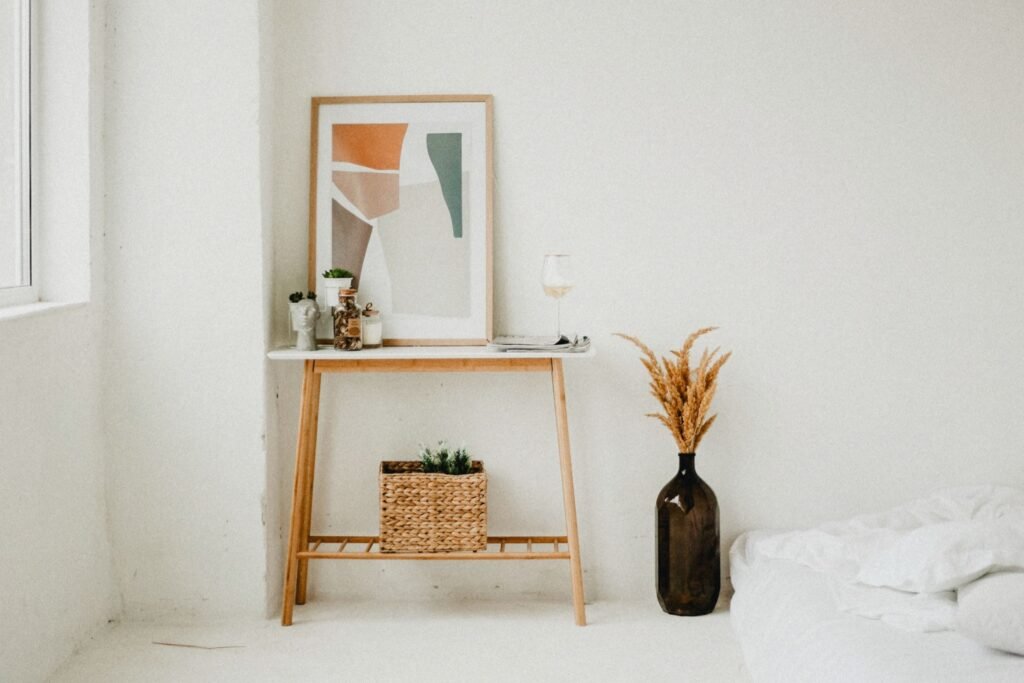
These ten give a home 80 percent of its calm. Each one comes with what to look for, Minimalist Home Decor Essentials a size rule and a budget range. Price ranges are approximate USD estimates and vary a lot by country and retailer, so check current prices before you buy.
1. A comfortable main seat
Your sofa or lounge chair is the anchor of the main room. Minimalist Home Decor Essentials Pick a simple silhouette with slim legs or a plinth base, and a durable fabric such as tightly woven cotton, linen blend or performance fabric in a neutral shade.
- Size rule: leave about 30 to 36 inches (75 to 90 cm) of walkway around it.
- Budget: around $400 to $900. Mid: $900 to $2,000. Invest: $2,000 and up.
- Smart swap: a good second-hand sofa with new slipcovers.
2. A simple bed with quality bedding
A clean-lined frame and one good set of neutral bedding creates instant calm. Minimalist Home Decor Essentials Skip decorative layers. One duvet, two sleeping pillows, and one or two textured cushions are enough.
- Size rule: leave about 24 inches (60 cm) on each side you use to get in and out.
- Budget: a frame around $200 to $500, bedding $80 to $200. Spend the most on the mattress and sheets.
3. Layered lighting
Lighting does more than any single piece of decor. A minimalist room needs three layers: Minimalist Home Decor Essentials a main light (ambient), a lamp for tasks like reading, and a soft accent light. Use warm-white bulbs (around 2700K) and, where possible, a dimmer.
- Size rule: a floor lamp should light a reading spot from beside or behind your shoulder, with the bottom of the shade at about seated eye level.
- Budget: $30 to $120 per lamp.
4. One correctly sized area rug
A rug defines a zone and adds softness. Minimalist Home Decor Essentials The most common mistake is buying one that is too small.
- Size rule (living room): at least the front legs of the sofa and chairs should sit on the rug. A common size for a standard living room is 8 by 10 feet (about 240 by 300 cm).
- Material: wool or a wool blend ages well. Choose low pile and a solid or very subtle texture.
- Budget: $150 to $500 for synthetic or flatweave, $500 and up for wool.
5. Floor-length curtains or light-filtering shades
Window treatments soften a room and control light. Minimalist Home Decor Essentials White or neutral linen is a classic choice.
- Size rule: hang the rod 4 to 6 inches (10 to 15 cm) above the window frame, or close to the ceiling, and let curtains reach the floor. For a full, relaxed look, buy fabric about 1.5 to 2 times the width of the window.
- Budget: $40 to $200 per panel for ready-made, more for custom.
6. Closed storage
Clutter is the enemy of minimalism, and closed storage hides it. Minimalist Home Decor Essentials A sideboard, a cabinet with doors, or lidded baskets let you keep everyday items out of sight.
- Size rule: choose storage that holds 20 to 30 percent more than you own today, so the room does not refill with clutter.
- Budget: $150 to $600.
7. One large mirror
A large mirror bounces light and makes small rooms feel bigger.
- Size rule: if hanging above a console or sideboard, the mirror should be about two-thirds the width of the furniture below it. Place it opposite or beside a window, not directly across from clutter.
- Budget: $60 to $300.
8. One large piece of art
One big piece has more impact than a gallery wall of small ones, and it fits the minimalist idea of a single focal point.
- Size rule: hang art so its center sits at about 57 to 60 inches (145 to 150 cm) from the floor, Minimalist Home Decor Essentials and make it about two-thirds the width of the furniture beneath it.
- Budget: $30 for a quality print and simple frame, up to hundreds for original work.
9. One healthy plant
Greenery adds life and color without clutter. Minimalist Home Decor Essentials Choose a plant that suits your light: a snake plant or ZZ plant for low light, a fiddle-leaf fig or olive tree for bright rooms.
- Size rule: one large plant in a simple pot has more impact than five small ones.
- Budget: $20 to $100.
10. A textured throw and a few cushions
These are the easiest way to add warmth. Choose one throw and two or three cushions in textures like wool, boucle or linen, in tones from your palette.
- Budget: $30 to $120.
7 More Essentials to Add Next
Once the Core 10 are in place, add these as your needs and budget allow.
11. A coffee table
Choose a low, simple shape. Leave about 14 to 18 inches (35 to 45 cm) between the sofa and the table, and aim for a table about two-thirds the length of the sofa.
12. A side table
One small table within reach of your seat is more useful than three decorative ones.
13. Bedside tables
One on each side, with a drawer or shelf so cables, books and chargers stay hidden.
14. Entryway hooks and a tray
Hooks for coats and bags, and one tray for keys. This single zone prevents clutter from spreading through the home.
15. Open shelving or a bookcase
Open shelves are fine in minimalism if you style them sparingly. Minimalist Home Decor Essentials Keep a third of each shelf empty, and group items by color or material.
16. A ceramic vase or bowl
One handmade-looking vase or bowl adds texture. It can be empty or hold a single branch.
17. A matching bathroom set
One soap dispenser, matching towels and a small tray. Nothing else on the counter.
5 Optional Essentials (Only If You Love Them)
These are not necessary, but can add personality.
18. Candles or a diffuser
Choose one scent and keep it consistent through the home.
19. A wall clock
A simple one with clear numerals is both decor and function.
20. One sculptural object
A single object with an interesting shape gives the eye a place to rest.
21. A large floor basket
Useful for blankets or toys, and it adds natural texture.
22. An ottoman or stool
Extra seating that doubles as a table or footrest.
Minimalist Home Decor Essentials Sizing Cheat Sheet
Use these as starting points. Minimalist Home Decor Essentials Always measure your own room, and tape the outline on the floor before buying.
| Item | Practical guideline |
|---|---|
| Walkways | 30 to 36 in (75 to 90 cm) |
| Living room rug | Front legs of furniture on the rug; common size 8 by 10 ft (240 by 300 cm) |
| Coffee table | 14 to 18 in (35 to 45 cm) from sofa; about two-thirds sofa length |
| Curtains | Rod 4 to 6 in (10 to 15 cm) above frame; to the floor; fabric 1.5 to 2 times window width |
| Art | Center about 57 to 60 in (145 to 150 cm) from floor; about two-thirds furniture width |
| Mirror above furniture | About two-thirds the width of the furniture |
| Floor lamp | Shade bottom around seated eye level |
| Shelves | Leave about one-third empty |
Lighting in a Minimalist Home
Poor lighting makes even a beautiful room feel flat. Use all three layers:
- Ambient: the main light. Use a ceiling fixture on a dimmer, or several lamps for a softer effect.
- Task: lamps for reading, cooking and working. Place them where you actually use them.
- Accent: small lights that highlight art, plants or shelves.
Choose warm-white bulbs, around 2700K to 3000K, for living areas and bedrooms. Cooler light is better suited to kitchens and workspaces. Use the same bulb color throughout a room so the light feels consistent.
Color Palette and Materials
Minimalism does not have to be white and grey. Warm minimalism uses cream, oatmeal, sand and soft browns, with natural materials for depth.
| Material | Why it works | Care |
|---|---|---|
| Linen | Soft, relaxed look, ideal for curtains and bedding | Wash gently, expect natural creasing |
| Wool | Warm and durable, great for rugs and throws | Vacuum regularly, spot clean |
| Oak or ash | Light, warm wood that suits most palettes | Wipe clean, avoid standing water |
| Ceramic and stone | Adds weight and a handmade feel | Wipe with a damp cloth |
| Matte metal | Slim accents on lamps and frames | Dust regularly |
Minimalist Home Decor Essentials by Room
Use these quick checklists to see what each room truly needs.
Living room: comfortable seat, rug, coffee or side table, floor lamp, curtains, closed storage, one large art piece, one plant.
Bedroom: bed with quality bedding, two bedside tables or one, warm lamp, curtains or blackout shades, a mirror, a basket for laundry.
Kitchen: clear counters with only daily-use items, a good knife and cutting board, a few matching containers, one bowl for fruit, a simple dish rack.
Bathroom: matching towels, one soap dispenser, a small tray, a plant if there is light, closed storage for the rest.
Entryway: hooks, a tray for keys, a bench or shoe rack, a small mirror.
Home office: a good chair, a simple desk, a task lamp, cable management, one shelf.
Dining area: a table and chairs that fit comfortably, a pendant or lamp for warm light, one centerpiece.
Minimalist Home Decor Essentials on a Budget
You do not need to buy everything new. A smart order of spending gets the best result.
| Tier | Where to spend | Where to save |
|---|---|---|
| Budget | Bedding, bulbs and one good lamp | Vases, trays, cushions (second-hand or simple) |
| Mid-range | Sofa, rug, curtains | Side tables, art prints |
| Investment | Mattress, sofa, lighting | Decorative objects |
Where to save: accessories, vases, trays, frames and shelves. Second-hand shops, marketplaces and clearance sections are full of simple, well-made pieces.
Where to spend: anything you sit on, sleep on or use daily. Quality here lasts longer and avoids replacement costs, which is also the more sustainable choice.
Minimalist Home Decor Essentials for Small Apartments and Renters
Small spaces benefit the most from minimalism, and renters can do almost all of it without drilling.
- Choose furniture that does two jobs: a storage ottoman, a bed with drawers, a fold-out table.
- Go vertical: tall shelves and wall hooks use space you were not using.
- Use light colors and mirrors to make rooms feel larger.
- Use adhesive hooks and picture ledges instead of nails. Check the weight limit on the packaging.
- Use freestanding lamps instead of wired fixtures, and plug-in wall lights where allowed.
- Use tension rods and curtain panels to hide clutter and divide space.
- Keep it removable: rugs, throws, plants and freestanding storage go with you when you move.
Minimalist Home Decor Essentials With Kids and Pets
Minimalism works with children and animals if you plan for them.
- Use washable fabrics, such as removable slipcovers and machine-washable rugs.
- Give toys a closed home, such as lidded baskets or low cabinets that children can use themselves.
- Avoid fragile objects at floor or low table level.
- Choose darker or textured neutrals in high-traffic areas, which hide marks better than pure white.
- Keep cords and small decorative objects out of reach.
Where to Start: A 7-Day Starter Plan
- Day 1: Clear one surface completely and keep only what you use daily.
- Day 2: Sort one cupboard or closet into keep, donate and toss.
- Day 3: Measure your main room and tape the rug and furniture sizes on the floor.
- Day 4: Swap harsh bulbs for warm ones and add one lamp.
- Day 5: Choose your palette, three base colors and one accent.
- Day 6: Add closed storage or baskets for visible clutter.
- Day 7: Add one large art piece, one plant and one throw. Stop there and live with it for a week.
8 Minimalist Decor Mistakes to Avoid
- Buying decor before decluttering. You end up styling clutter.
- Rugs that are too small. The room feels broken up.
- Using only cool white and grey. The space feels cold. Add warm neutrals and texture.
- One harsh ceiling light. Layer your lighting.
- Too many small objects. Use fewer, larger pieces.
- Matching everything. A little variation in texture and tone is what makes it feel designed.
- Forgetting storage. Minimalism only works if clutter has somewhere to go.
- Following trends instead of your life. If you do not use it, it is clutter.
Common Myths
- “Minimalism means white walls and an empty home.” It means choosing intentionally. Many minimalist homes are warm and full of texture.
- “It is expensive.” Often the opposite. You buy less, and second-hand pieces work well.
- “You must own fewer than 100 things.” There is no required number. The goal is a home that feels easy to live in.
Printable Checklist: Minimalist Home Decor Essentials
- I have decluttered the room before buying anything
- I measured the space and taped out the furniture
- I have a comfortable main seat and a simple bed
- I have three lighting layers with warm bulbs
- My rug is large enough for the furniture
- My curtains hang high and reach the floor
- I have closed storage for everyday clutter
- I have one large mirror and one large piece of art
- I have one healthy plant
- Every surface is about one-third empty
- Every item is useful, beautiful or both
Frequently Asked Questions About Minimalist Home Decor Essentials
What are the essentials of minimalist home decor?
The essentials are comfortable seating, a good bed, layered lighting, a correctly sized rug, simple window treatments, closed storage, a mirror, one large art piece, a plant and a textured throw. Everything else is optional.
How much does it cost to decorate a minimalist home?
It varies widely. A budget version of the Core 10 can cost roughly $1,000 to $2,500, while mid-range and investment pieces cost more. Second-hand furniture and simple accessories can lower the cost considerably.
What should I buy first for a minimalist home?
Start with lighting, a comfortable seat and a bed. These affect daily comfort the most, and they make the biggest visual change.
How many decor items should a minimalist room have?
There is no fixed number. A useful guide is to leave about a third of every surface empty, and to choose a few larger pieces over many small ones.
Is minimalist decor boring or cold?
Not if you use warm neutrals, natural textures, plants and good lighting. Warm minimalism feels calm, not empty.
Final Thoughts
The best minimalist home decor essentials are the ones you use and enjoy every day, in the right size, in light you love. Start with the Core 10, measure before you buy, protect your empty space and add slowly. A calm home is built one thoughtful choice at a time, so pick one item from the starter kit today and finish it before you buy anything else.