How to Hang Curtains: The Complete Step-by-Step Guide (Rod Height, Measurements and Hardware)


how to hang curtains, measure your window, mount the rod 4 to 6 inches (10 to 15 cm) above the window frame, extend it 8 to 12 inches (20 to 30 cm) past each side, fix the brackets into studs or the correct wall anchors, thread the curtains onto the rod, and hang them so the hem just clears the floor. Choose panels that are at least twice as wide as the rod so they fall in full, soft folds.
That is the short version. Below is the full guide: how to hang curtains exact numbers, a worked example, the right method for every wall type and curtain style, and the mistakes that make curtains look wrong even when the fabric is beautiful.
Key Takeaways
- Measure before you buy anything. Rod, curtains and hardware all depend on four numbers: window width, rod width, rod height and curtain drop.
- Hang high and wide. A rod set higher and wider than the window makes the window look larger and the ceiling taller, and it lets daylight in when the curtains are open.
- Fullness matters. Curtain width should be 1.5 to 2.5 times the rod width, depending on the fabric.
- Match the fixings to the wall. Drywall, plaster, concrete and brick all need different plugs or anchors.
- Support long rods. Any rod longer than about 48 inches (120 cm) needs a centre support bracket, or it will sag.
- Let the curtains settle. New folds relax over a few days, so do not judge the result on day one.
Tools and Materials You Need Before You Start

Gather everything first. Climbing a ladder three times because you forgot the pencil is how mistakes happen.
| Item | Why you need it |
|---|---|
| Steel tape measure | Fabric or plastic tapes can stretch and give false readings |
| Pencil | For marking bracket positions on the wall |
| Spirit level (or laser level) | A rod that is even 5 mm out of level looks crooked once the curtains hang |
| Stud finder | Locates studs behind drywall, where the strongest fixing points are |
| Drill and drill bits | Pilot holes and anchor holes (masonry bits for brick or concrete) |
| Screwdriver | Fitting brackets and finials |
| Wall anchors or plugs | Matched to your wall type (see the wall types section below) |
| Step ladder | Tall enough to reach the rod height without stretching |
| Curtain rod or track, brackets, finials | Sized for your window and the weight of your fabric |
| Rings, clips or hooks | Matched to the curtain header style |
| Steamer or iron | To remove fold creases once the curtains are up |
Safety first: Before drilling, check for hidden electrical cables and water pipes. how to hang curtains A stud finder with live-wire detection helps. Wear eye protection, and a dust mask when drilling into brick, plaster or concrete. Never overreach on a ladder: move it instead.
How to Measure for Curtains

Measure before you buy curtains, a rod or hardware. Every later decision depends on these four numbers.
Step 1: Measure the window width
Measure the width of the window including the trim or frame, from outer edge to outer edge. Write it down. In this guide we will use a worked example: a window that is 60 inches (152 cm) wide.
Step 2: Decide your rod width
The rod should be wider than the window so the curtains can stack beside it instead of covering the glass. Add 8 to 12 inches (20 to 30 cm) on each side of the window.
Formula: rod width = window width + (2 x side extension)
Example: 60 in + (2 x 10 in) = 80 inches (203 cm) rod
If wall space is tight (a corner, or a neighbouring wall), how to hang curtains extend by at least 4 to 6 inches (10 to 15 cm) per side. Less than that and the curtains will cover part of the glass even when fully open.
Step 3: Decide your rod height
Measure from the floor to the top of the window frame, then add the rod height above the frame.
- Standard look: 4 to 6 inches (10 to 15 cm) above the frame
- Taller look or low ceilings: up to 12 inches (30 cm) above the frame, or about 2 to 3 inches (5 to 8 cm) below the ceiling
- Very high ceilings (over 10 feet / 3 m): keep the rod in proportion to the window, usually 6 to 12 inches (15 to 30 cm) above the frame, rather than chasing the ceiling
Example: The top of the frame is 82 inches (208 cm) from the floor. Add 5 inches (13 cm) and the rod sits at 87 inches (221 cm).
Step 4: Calculate the curtain drop (length)
Measure from the rod position down to where you want the curtain to end. how to hang curtains Then adjust for the hanging hardware, because rings, clips and hooks add a little drop below the rod.
Formula: drop = rod height – floor clearance – hardware drop
Example: 87 in – 0.5 in clearance – 2 in for rings and clips = about 84.5 inches (215 cm).
An off-the-shelf 84 inch (213 cm) panel hovers about 1 inch (2.5 cm) above the floor, which is a clean, practical finish. If you want an exact fit, order a custom length or hem the next size up.
Measurement cheat sheet
| What | Inches | Centimetres |
|---|---|---|
| Rod height above window frame (standard) | 4 to 6 in | 10 to 15 cm |
| Rod height for a taller look | up to 12 in | up to 30 cm |
| Rod extension past each side of window | 8 to 12 in | 20 to 30 cm |
| Minimum extension in tight spaces | 4 to 6 in | 10 to 15 cm |
| Curtain width (fullness) | 1.5 to 2.5 x rod width | 1.5 to 2.5 x rod width |
| Hem clearance from floor | 0.5 to 1 in | 1 to 2.5 cm |
| Centre support needed when rod is longer than | 48 in | 120 cm |
Standard ready-made curtain lengths are usually 84 in (213 cm), 95 to 96 in (241 to 244 cm), 108 in (274 cm) and 120 in (305 cm). As a rough guide, how to hang curtains 84 inch panels suit standard rod heights on lower ceilings, 95 or 96 inch panels suit typical 8 foot (2.4 m) ceilings with a high-mounted rod, and 108 or 120 inch panels suit 9 to 10 foot (2.7 to 3 m) ceilings. Always confirm with your own measurements rather than assuming.
Choosing Your Curtain Length: Sill, Apron, Floor or Puddle
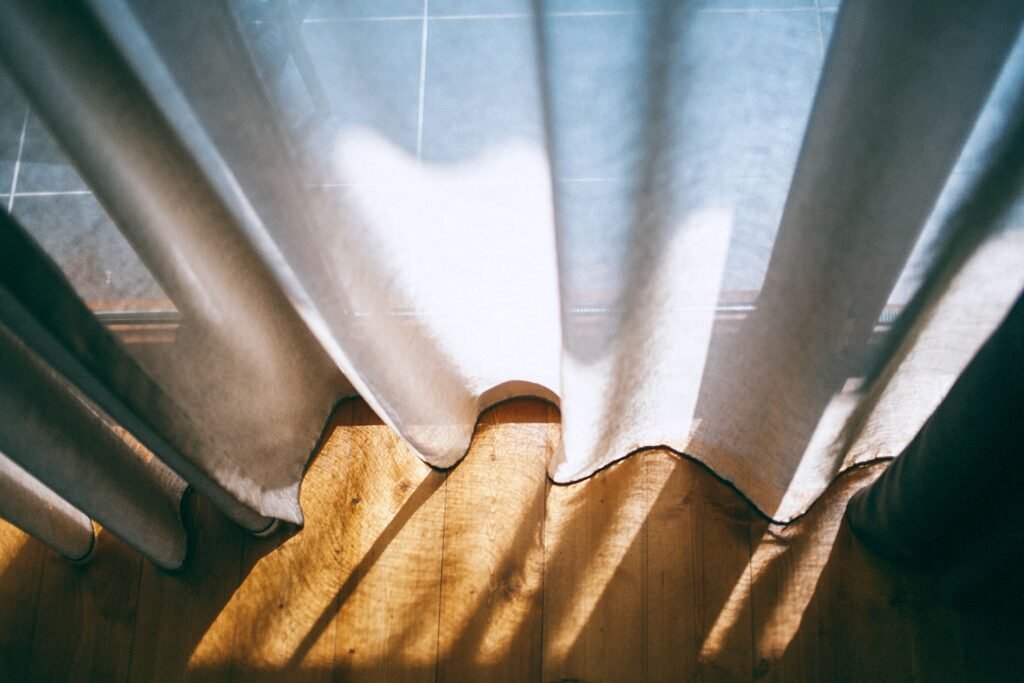
Decide the finish point before measuring the drop, because it changes the look of the room.
| Style | Where it ends | Best for |
|---|---|---|
| Sill length | Just touching or 0.5 in (1 cm) above the sill | Kitchens, bathrooms, windows with a desk or radiator below |
| Apron length | 4 to 6 in (10 to 15 cm) below the sill | Windows where full length is impractical but sill length looks too short |
| Floor length (hover) | 0.5 to 1 in (1 to 2.5 cm) above the floor | Living rooms and bedrooms; the most polished, practical choice |
| Break | Just brushes the floor | A relaxed, slightly softer look |
| Puddle | 2 to 6 in (5 to 15 cm) of fabric on the floor | Formal, traditional rooms; collects more dust and is harder to clean |
If you are unsure, choose floor length (hover). Too short is the most common curtain error, and it is the hardest to fix. When in doubt, buy longer and hem them.
How Much Fabric Do You Need? Curtain Fullness Explained
Fullness is the ratio of the total curtain width to the rod width. It is what creates soft folds instead of a flat, stretched look.
- 1.5 times: the minimum, suited to light sheers or a modern, flatter look
- 2 times: the standard for most curtains and the best default
- 2.5 times: a rich, luxurious fold, common for heavy lined drapes and pinch pleat styles
Example: With an 80 inch (203 cm) rod and 2x fullness, you need 160 inches (406 cm) of total finished width. That is two panels of 80 inches (203 cm) each.
Check whether the listed panel width is the fabric width before pleating or the finished width after pleating. how to hang curtains This detail is easy to miss and is a common reason curtains look thin once hung.
Curtain Header Styles and the Hardware They Need
The top of the curtain, called the header, decides which hardware you need and how the curtain hangs.
| Header style | How it attaches | Slides easily? | Notes |
|---|---|---|---|
| Rod pocket | Rod threads through a sewn channel | No, tends to stick | Gathered, casual look; best for curtains that stay put |
| Tab top | Fabric loops slide over the rod | Moderately | Relaxed look; rod stays visible |
| Grommet (eyelet) | Rod passes through metal rings in the fabric | Yes | Clean, modern folds; the easiest to hang |
| Back tab | Hidden loops at the back | Moderately | Hides the rod; neat, tailored look |
| Pinch pleat | Pleats attached with hooks and rings or a track | Yes, with rings | Formal; holds shape well |
| Pencil pleat (tape headed) | Tape on the back with hooks into rings or a track | Yes | Dense, even gathers common in the UK and Europe |
| Ring clip | Clips attach any flat-top panel to rings | Yes | Most flexible; easy to adjust height |
If you are replacing curtains and want maximum flexibility, how to hang curtains ring clips let you fine-tune the length by moving the clip position.
Rod or Track: Choosing the Right Hardware
Curtain rods
Rods suit most homes and show off decorative finials. For heavy lined, how to hang curtains blackout or velvet curtains, choose a sturdier rod (generally 1 inch / 25 mm in diameter or thicker) and brackets rated for the weight. Thin hollow rods can bow under heavy fabric.
Curtain tracks
Tracks are mounted to the wall or ceiling and are ideal for floor-to-ceiling windows, wide spans, bay windows and a streamlined, hidden-hardware look. how to hang curtains Curtains glide smoothly on gliders, and tracks can be bent for curved or bay windows.
Bracket spacing and support
- Fit a bracket near each end of the rod, so the finials sit just outside the brackets (usually 2 to 3 inches / 5 to 8 cm in from the rod ends).
- For rods longer than 48 inches (120 cm), add a centre support bracket.
- For very long rods or heavy fabric, add further brackets so that no unsupported span is longer than about 48 inches (120 cm).
- A centre bracket is the single most overlooked part of a good installation. Without one, long rods sag within weeks.
How to Hang Curtains Step by Step
With your measurements ready and the right hardware chosen, how to hang curtains the actual installation follows a clear order. These steps apply to a standard drilled rod installation; the track and no-drill versions follow below.
- Mark the rod height. Measure up from the floor and make a small pencil mark at your calculated rod height on each side of the window.
- Mark the bracket positions. Measure out from the window frame by your side extension (8 to 12 inches / 20 to 30 cm), then move in 2 to 3 inches (5 to 8 cm) so the finials sit just outside the bracket. Mark for the end brackets and the centre support.
- Check with a level. Hold a spirit level against your marks and confirm they are even. Check again. Walls and ceilings are rarely perfectly level, so trust the level, not the ceiling line.
- Locate studs. Use a stud finder and mark the stud positions. Where a bracket falls on a stud, drill a pilot hole and screw directly in. Where it does not, use anchors suited to the wall.
- Drill pilot holes and fit anchors. Use the correct bit size, drill straight, and insert anchors if needed.
- Fix the brackets. Screw the brackets firmly to the wall, and check they are level and the same height.
- Prepare the curtains on the floor. Attach the rings, clips or hooks, and slide the curtains onto the rod before lifting it into place. Heavy curtains are much easier to hang this way than adding them to a rod that is already up.
- Lift the rod into the brackets. Ideally with a second person. Tighten the bracket screws, and fit the finials.
- Arrange the folds. Open and close the curtains fully and distribute the fabric evenly.
- Check and adjust. Step back and look at the height, the level, and the hem. Adjust clips or rings if needed.
How to Hang Curtains on a Rod (Rings, Clips, Tabs, Grommets)
- Rings with clips: Clip each ring about 3 to 4 inches (8 to 10 cm) apart along the top edge. Put one clip about 1 inch (2.5 cm) from each edge, then space the rest evenly. The more clips, the more even the folds.
- Tab top and back tab: Slide the rod through the loops, starting from the outside edge. Make sure the front of the fabric faces the room.
- Grommet (eyelet): Thread the rod through each ring in turn. Create even folds by spacing the grommets before you lift the rod into the brackets.
- Rod pocket: Gather the fabric onto the rod in a bunched, casual style, and fix with a finial. This style does not slide, so it suits windows where the curtains stay mostly closed.
- Pinch and pencil pleat: Insert hooks into the pleat pockets or tape, spacing them evenly, then hook into the ring eyes on the rod. Pin hooks go directly into pleats on a track system.
Tip: leave the first and last ring at each end of the rod outside the bracket, so that the curtain can sit against the wall when open without catching the bracket.
How to Hang Curtains on a Track
- Decide whether the track is mounted to the ceiling (cleanest finish, best for floor-to-ceiling) or the wall above the window.
- Mark and fix the track brackets, usually every 12 to 20 inches (30 to 50 cm), or as the manufacturer states. Tracks need more support points than rods because they run the full width.
- Allow for the end stops when you position the last hooks, so the curtains do not run off the end.
- Attach the curtain to the gliders using hooks. Set the hook position so the track is hidden behind the header.
- Test the movement by opening and closing fully. Gliders should run freely.
Ceiling tracks are the best answer for floor-to-ceiling glass and sliding doors, because they give a continuous, uncluttered line.
How to Hang Curtains Without Drilling
If you rent, or you do not want holes in the wall, there are safe alternatives. how to hang curtains Be realistic about their limits: no-drill options generally hold lighter curtains than a screwed-in bracket.
| Method | Works best for | Limits |
|---|---|---|
| Tension rod (spring-loaded, fits inside the window recess) | Light sheers, café curtains, small windows | Weight limit is low; can slip on smooth surfaces; only works where the recess is solid |
| Adhesive hooks or brackets | Light curtains on smooth, clean walls | Check the weight rating; the surface must be clean and dry; may damage paint when removed |
| Over-the-door or window-frame clips | Temporary or very light curtains | Not for permanent or heavy use |
| Ceiling-mounted track with adhesive or clip fixings | Light panels, room dividers | Weight limits apply |
| Hanging from a window frame with removable hooks | Sheers, privacy curtains | Check the frame can carry the load |
For heavy lined or blackout curtains, a drilled installation is more reliable. how to hang curtains If you need to remove the rod when you move out, fill the small pilot holes with filler and touch up the paint, which is far less visible than a failed adhesive fixing.
How to Hang Curtains on Different Wall Types
The wall decides your fixing. Using the wrong anchor is a common reason brackets pull out, so identify the wall before buying screws.
| Wall type | How to identify | Best fixing |
|---|---|---|
| Drywall (plasterboard) with a stud | A stud finder beeps; the wall sounds solid when tapped | Screw directly into the stud with wood screws |
| Drywall without a stud | Hollow sound when tapped | Self-drilling or toggle anchors rated for the weight; avoid basic plastic plugs for heavy curtains |
| Plaster over lath or brick | Hard surface, sometimes cracks when drilled | Drill carefully with a masonry or multi-purpose bit; use suitable wall plugs; pre-drill and go slowly to avoid cracking |
| Brick or concrete | Very hard; drilling takes effort | Hammer-drill with a masonry bit; use plastic or nylon wall plugs with matching screws |
| Gypsum board ceilings and partitions | Hollow; common in many modern apartments | Special gypsum or toggle anchors; do not use plugs designed for solid concrete |
| Window frame or wood trim | Solid wood | Short screws only, to avoid splitting; check the frame is strong enough |
Heavier curtains need stronger fixings. If a bracket cannot go into a stud or a solid wall, use anchors with a weight rating higher than you expect to need.
How to Hang Curtains on Special Windows
Standard advice does not fit every window. These are the situations where people most often go wrong.
Floor-to-ceiling windows and sliding doors
A ceiling-mounted track is usually the cleanest solution, as it removes any visual break above the glass. If you use a rod, mount it as close to the ceiling as possible and let the curtain fall to the floor. how to hang curtains Make sure the curtains stack beyond the door opening so people can pass freely, which means a wider extension than usual.
Bay windows
Use a flexible or bendable track, or a set of angled rods, so the curtains follow the shape. Measure each section separately. A single straight rod across the front of a bay usually leaves awkward gaps.
Corner windows
Treat each wall as its own window if you can, and avoid blocking the corner. Use a corner track or two separate rods meeting at the corner, and allow clearance so the curtains do not collide.
Short or small windows
Hang the rod higher than the window to create height, and use a longer curtain than the window strictly needs. Alternatively, choose sill length for a tidy, practical result in kitchens and bathrooms.
Windows with a radiator, desk or furniture below
Keep curtains from touching the heater, which can damage fabric and block heat. how to hang curtains Sill-length or apron-length curtains are the sensible choice, or hang floor-length curtains that stop clear of the radiator.
Very high or sloped ceilings
Keep the rod in proportion to the window rather than the ceiling. For sloped ceilings, a wall-mounted rod at a consistent height gives a more even look than following the slope.
Windows close to the ceiling
If there is less than 4 inches (10 cm) between the frame and the ceiling, mount the rod as high as the space allows, or use a ceiling-mounted track.
Finishing Touches: Making Curtains Look Professional
- Steam, do not iron, where possible. Steam removes fold creases gently. Hang the curtains first, then steam them in place, working from the top down. Check the care label first.
- Train the folds. For pleated or heavy curtains, gather the folds neatly and loosely tie them with a soft strip of fabric for a day or two, then remove the ties. This helps the pleats fall into shape.
- Layer for function and style. Hang sheers on the rod closest to the window and heavier drapes on the outer rod. A double rod gives privacy by day and darkness at night.
- Add tiebacks or holdbacks to keep curtains open neatly and let in light. Place them at roughly one third of the way up from the floor.
- Fix gaps. If light leaks at the sides, widen the rod or use a return rod (a rod that curves back to the wall) to close the gap.
Common Mistakes When Hanging Curtains (and How to Fix Them)
| Mistake | Why it is a problem | Fix |
|---|---|---|
| Hanging the rod directly on the window frame | Makes the window and ceiling look smaller | Mount 4 to 6 in (10 to 15 cm) higher, and extend the rod wider |
| Rod too short | Curtains cover the glass even when open | Extend 8 to 12 in (20 to 30 cm) per side |
| Curtains too short | Looks unfinished; “flood” length | Hang higher, buy longer panels, or hem a longer pair |
| Panels too narrow | Flat, thin, and gaps when closed | Use 2x fullness, adding extra panels if needed |
| No centre support | Rod sags in the middle | Add a centre bracket for rods over 48 in (120 cm) |
| Wrong anchors | Brackets pull out of the wall | Match the anchor to the wall type and weight |
| Not using a level | Crooked rod, uneven hem | Check with a spirit level at every stage |
| Measuring once | Errors in the drop or width | Measure twice, mark, then measure again |
| Ignoring hardware drop | Curtains end up too short | Subtract ring and clip drop from the length |
| Hanging curtains when walls are damp or freshly painted | Fixings fail | Wait until the surface is dry and cured |
Troubleshooting: Fixing Curtains After You Hang Them
- The curtains look creased. Steam them in place, or leave them to hang for a few days. Most fold lines drop out on their own.
- The rod is sagging. Add a centre support bracket or swap to a sturdier rod.
- One side hangs lower. Check the brackets with a level. If the rod is level but the curtain is not, adjust the clip positions.
- There is a gap of light in the middle. Overlap the inner edges, use a wider panel set, or add a centre overlap or a return rod.
- The curtains hang too short. Lower the rod slightly, move to a longer panel, or add a decorative band at the hem.
- The curtains pool unevenly. Check the floor is level. If it slopes, hem to the average, or hang to the higher side of the floor.
- The curtains do not slide smoothly. Check rings fit the rod diameter, and wipe or lubricate the rod. For tracks, make sure gliders are not jammed.
- The curtains block light even when open. Extend the rod further past the window, or choose a narrower stack.
Caring for Your Curtains
Check the care label. Many curtains can be vacuumed on a gentle setting or shaken out regularly to remove dust. Wash or dry-clean as the label directs, and allow for slight shrinkage. how to hang curtains Lined curtains often need dry cleaning, and washing them incorrectly can distort the lining. Rotate or air them occasionally if they sit in direct sunlight, since UV light fades fabric over time.
FAQs About How to Hang Curtains
How high should I hang curtains above a window?
A standard height is 4 to 6 inches (10 to 15 cm) above the window frame. For a taller look, go as high as 12 inches (30 cm) above the frame or just below the ceiling, as long as the proportions still look balanced.
How wide should a curtain rod be?
Extend the rod 8 to 12 inches (20 to 30 cm) past each side of the window frame. In tight spaces, a minimum of 4 to 6 inches (10 to 15 cm) per side still helps the curtains clear the glass.
How long should curtains be?
For most rooms, floor length is best, with the hem hovering 0.5 to 1 inch (1 to 2.5 cm) above the floor. Sill or apron length suits windows with a radiator, desk or other furniture below.
How wide should curtains be?
The total curtain width should be 1.5 to 2.5 times the rod width. Two times is a good default. Sheers can go lower, while pinch pleat and heavy drapes look best at 2.5 times.
Do I need a centre support bracket?
Yes, for rods longer than 48 inches (120 cm). Without it, the rod will bow in the middle over time, especially with heavy fabric.
Can I hang curtains without drilling holes?
Yes, using tension rods, adhesive hooks or clip-on options. They work best for lightweight curtains. For heavy, lined or blackout curtains, a drilled installation is safer.
Should I hang the curtains first or the rod first?
Attach the rings or clips and slide the curtains onto the rod first, then lift the rod into the brackets. It is much easier with heavy curtains. Use a second person to help lift if the rod is long.
What if the studs do not line up with my brackets?
Use wall anchors rated for the weight, such as toggle or self-drilling anchors for drywall. Alternatively, mount a wooden mounting board on studs and fix the brackets to the board.
How do I hang curtains on sliding doors or floor-to-ceiling windows?
A ceiling-mounted track gives the cleanest result. If using a rod, mount it high and wide so the curtains stack clear of the door opening, and let the fabric fall to the floor.
How long before new curtains hang straight?
Usually a few days. Folds from packaging relax with use, steaming, and gentle arranging. If a section still looks uneven after a week, redistribute the folds by hand.
Final Thoughts
Good curtains come down to three decisions made before you pick up the drill: accurate measurements, hardware that suits your wall and fabric weight, and a header style that matches how you use the window. Hang the rod high and wide, give the fabric plenty of fullness, support long spans, and choose a length that skims the floor.
Once you know how to hang curtains with these principles, the job becomes a short, ordered checklist instead of guesswork. Take your time on the measuring, use a level at every stage, and you will end up with curtains that look professionally fitted and stay that way for years.