Round Dining Table: How to Choose the Right Size, Style, and Material

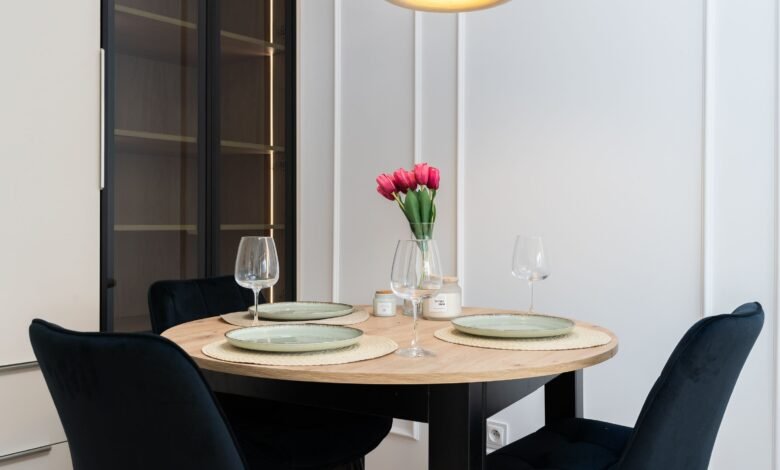
round dinning table can make a room feel warmer, softer and more social. Without sharp corners, it invites people to face each other, share dishes and stay at the table a little longer. But it is also easy to get wrong. A table that is only a few inches too wide can block a doorway, trap people against a wall, or leave guests unable to pull their chairs out.
This guide is built to help you avoid those mistakes. Instead of showing a list of products, round dinning table it explains the numbers and trade-offs behind a good choice: diameter and seating, room clearance, base type, material, maintenance, accessibility and buying checks. All measurements are given in both inches and centimetres, so the advice works wherever you live.
Why Choose a round dinning table?

Benefits for conversation and shared meals
Everyone sits at an equal distance from the centre, and everyone can see everyone else’s face. There is no “head of the table”, which is why round tables feel relaxed and work well for families, round dinning table friends and small gatherings. Conversation tends to stay in one group instead of splitting between two ends of a long rectangle.
Other practical advantages:
- No sharp corners. This is a real benefit in homes with toddlers, and in tight spaces where you brush past the table every day.
- Easier traffic flow. In a small or square room, a round shape removes corners that you would otherwise walk around.
- Flexible seating. Because there are no fixed sides, you can often squeeze in one extra chair when guests arrive.
- Space efficiency in small dining areas. For two to four people, a round table often uses less floor area than a rectangle of similar comfort.
Where round tables work best, and where they may not

Round tables suit square rooms, breakfast nooks, round dinning table bay windows, kitchens with a defined eating corner and open-plan spaces where the table sits “floating” in the room.
They are less ideal in these situations:
- Long, narrow rooms. A rectangular or oval table follows the shape of the room better and wastes less floor space.
- Large gatherings. Beyond about 72 in (183 cm) in diameter, people sitting opposite each other are too far apart to talk comfortably, and reaching dishes in the middle becomes difficult.
- Against a wall or bench. A round table pushed against a wall wastes the curved edge and rarely looks or functions as well as a rectangle or square.
- Households that need lots of surface area. A round table has less usable edge space per person than a rectangular one of similar footprint, so place settings can feel tight.
Be honest about this before you buy. round dinning table The best round table is one that suits your room, not just one that looks good in a photo.
Round Dining Table Sizes and Seating Capacity

Seating capacity depends on diameter, chair width and how much elbow room you want. round dinning table The table below shows realistic, comfortable capacity. The “maximum” figure means a squeeze, not a relaxed meal.
| Diameter (in) | Diameter (cm) | Comfortable seating | Maximum (tight) | Typical use |
|---|---|---|---|---|
| 30–36 in | 76–91 cm | 2 | 3 | Bistro, breakfast nook, balcony |
| 40–42 in | 102–107 cm | 4 | 4 | Small apartment, kitchen |
| 44–48 in | 112–122 cm | 4 | 5 | Standard small family table |
| 52–54 in | 132–137 cm | 5 | 6 | Family of five or occasional guests |
| 60 in | 152 cm | 6 | 7 | Dining room, regular entertaining |
| 66–72 in | 168–183 cm | 6–8 | 8 | Large dining room |
| 78–84 in | 198–213 cm | 8 | 10 | Very large room; consider a lazy Susan |
These are guides, not rules. Chunky upholstered chairs with wide seats and arms take more room than slim wooden chairs, so always check the real chair width.
What diameter works for two people?
A table 30–36 in (76–91 cm) across is enough for two people to eat comfortably, round dinning table with space for a shared dish in the middle. It also works as a breakfast table, a laptop-and-coffee spot or a balcony set. Below 30 in (76 cm), two place settings begin to overlap.
Round dining table for four: dimensions and layout
This is the most searched size, and for good reason. A 42 in (107 cm) round table seats four adults comfortably in most homes, round dinning table and a 48 in (122 cm) table gives noticeably more breathing room for plates, glasses and shared dishes.
If you often have a fifth person, 48 in (122 cm) is the safer pick. If your room is small, 42 in (107 cm) with slim chairs will save significant space.
Round dining table for six or eight: when to size up
For six people, aim for 60 in (152 cm). Smaller than that and six people will be elbow to elbow. For eight, you need roughly 72–84 in (183–213 cm), but this is where the trade-offs begin: the centre of the table becomes difficult to reach, and conversation across the table becomes harder.
If you regularly host eight or more, consider two options:
- A lazy Susan (a rotating tray) in the centre, which makes shared dishes reachable on tables over about 54 in (137 cm).
- An extendable round table that converts to an oval, round dinning table so you use a compact size day to day and a larger one for guests.
How much clearance should you leave around the table?
This is the number most guides skip, and it is the one that decides whether a table feels comfortable or cramped.
- Minimum: 36 in (91 cm) from the table edge to the nearest wall or furniture. This lets someone pull out a chair and sit down, but not walk behind a seated person easily.
- Comfortable: 42–48 in (107–122 cm). This allows people to walk behind seated diners.
- Generous: 48 in (122 cm) or more, especially if the area is a main walkway or you have a sideboard or cabinet doors that open.
Even in a small room, do not go below 30 in (76 cm) of clearance. round dinning table Below that, chairs hit walls and the space becomes frustrating to use.
How to Measure Your Room Before Buying

Measure the dining area and walkways
Measure the width and length of the space where the table will sit, round dinning table and note anything that intrudes: radiators, door swings, windows that open inward, cabinets, steps, floor vents and lighting fixtures. Mark any doorway or hallway that people will walk through, because those routes need to stay clear.
Account for chair pull-out space
A dining chair needs roughly 18–24 in (46–61 cm) of space behind the table edge to be pulled out and sat in. round dinning table This is why clearance matters more than the table size itself. A table that technically fits in a room is useless if the chairs cannot move.
A simple room-fit calculation in inches and centimetres
Use this quick formula:
Minimum room width = table diameter + (2 × clearance)
Example (minimum clearance): a 48 in table with 36 in clearance on each side needs 48 + 72 = 120 in (10 ft). In metric: 122 cm + (2 × 91 cm) = 304 cm.
Example (comfortable clearance): the same 48 in table with 44 in clearance on each side needs 48 + 88 = 136 in (about 11 ft 4 in). In metric: 122 cm + (2 × 112 cm) = 346 cm.
For quick reference, here are the room sizes needed for common tables:
| Table diameter | Minimum room width | Comfortable room width |
|---|---|---|
| 36 in / 91 cm | 108 in / 274 cm | 124 in / 315 cm |
| 42 in / 107 cm | 114 in / 290 cm | 130 in / 330 cm |
| 48 in / 122 cm | 120 in / 305 cm | 136 in / 345 cm |
| 60 in / 152 cm | 132 in / 335 cm | 148 in / 376 cm |
| 72 in / 183 cm | 144 in / 366 cm | 160 in / 406 cm |
Tip: Cut a piece of cardboard or tape the circle on the floor with painter’s tape. round dinning table Place your chairs around it and walk through the room. It takes five minutes and prevents expensive mistakes.
Can a round table fit in a square room?
Yes, and it is one of the best fits. round dinning table A square room wastes the least space with a round table because the shape has equal clearance on all sides. In a square room measuring 10 × 10 ft (305 × 305 cm), a table up to about 48 in (122 cm) in diameter fits with minimum clearance.
Round Dining Table Styles and Bases
The base matters as much as the top, round dinning table and many guides overlook it. It decides how much legroom you have, how stable the table is and how easily chairs fit around it.
Pedestal base
A single central column or sculpted base.
- Pros: maximum legroom, no legs to bump into, chairs can be placed anywhere, easy to squeeze in an extra seat, good for wheelchair or mobility-aid users.
- Cons: can wobble on large or heavily loaded tops if the base is narrow, stone or glass tops need a properly weighted base, and very wide bases may stop chairs from tucking in fully.
Four-leg base
Traditional legs at the edge or slightly inset.
- Pros: very stable, often cheaper, feels familiar, works well for heavy tops.
- Cons: legs limit where chairs can sit and can clash with knees, especially when you try to seat extra guests.
Trestle or multi-leg and cross bases
Less common in round tables, but available in farmhouse and industrial styles.
- Pros: sturdy and visually distinctive.
- Cons: the cross-bars or base spread can interfere with feet and chairs, so they suit larger diameters better.
Quick rule: for small tables up to 48 in (122 cm), a pedestal gives the best legroom. round dinning table For larger tables, make sure the base is wide enough for stability, or choose a table with a heavier base or multiple supports.
Modern, farmhouse, minimalist, traditional and Scandinavian styles
- Modern: clean lines, glass or stone tops, slim metal or sculpted pedestal bases.
- Farmhouse: solid wood, chunky legs or a trestle base, often a warm or distressed finish.
- Minimalist: simple form, neutral colours, a thin top and a slim pedestal.
- Traditional: turned legs or a carved pedestal, rich wood tones.
- Scandinavian: light woods such as ash, birch or oak, tapered legs, a soft and natural look.
Style is the easiest part to choose. round dinning table Focus first on size, base and material, then match the look to your home.
Which Material Is Best?
There is no single best material. It depends on budget, household and how much maintenance you will tolerate.
| Material | Durability | Maintenance | Weight | Typical cost | Best for |
|---|---|---|---|---|---|
| Solid wood | High, can be refinished | Moderate: avoid heat and standing water | Heavy | Mid to high | Long-term family use |
| Wood veneer | Good if well made | Moderate: edges can chip, deep scratches hard to fix | Medium | Mid | Budget-conscious buyers |
| MDF / engineered wood | Moderate, weak against moisture | Low to moderate | Medium | Low | Short-term or budget use |
| Glass | Strong if tempered, can chip at edges | High: shows fingerprints | Heavy | Low to mid | Small, bright rooms |
| Marble / stone | High but can stain and etch | High: needs sealing, acid-sensitive | Very heavy | High | Statement dining rooms |
| Metal | High | Low | Medium to heavy | Mid | Modern or outdoor-style settings |
Solid wood and wood veneer
Solid wood is durable and can be sanded and refinished, round dinning table so it ages well. It reacts to humidity, so keep it away from radiators and strong sunlight. Veneer, a thin layer of real wood over a core, gives a similar look at a lower price. Quality varies widely: check that the edges are sealed and the veneer is thick enough to withstand wear.
Glass
Glass makes a small room feel bigger because you can see through it. Choose tempered glass at least 0.4 in (10 mm) thick for safety. It scratches less than people expect but shows every fingerprint and crumb. Not ideal if you have toddlers who will bang cutlery on it or dislike frequent wiping.
Marble and stone
Beautiful and long-lasting, but heavy and porous. round dinning table Marble can etch from lemon juice, vinegar or wine, and needs sealing. The weight also means you need a strong base and possibly two people to move it. If you love the look but not the maintenance, consider a porcelain or sintered-stone top, which imitates marble and resists stains better.
Metal and engineered materials
Metal bases or tops are tough and low maintenance. round dinning table Engineered materials such as MDF or laminate suit tight budgets but are less forgiving: water can cause swelling, and damaged laminate is difficult to repair.
Round vs Oval vs Square vs Rectangular Dining Tables
| Shape | Best room shape | Seating style | Strengths | Weaknesses |
|---|---|---|---|---|
| Round | Square or compact rooms | 2–6 comfortably | Conversation, flow, no corners | Large sizes hard to reach across |
| Oval | Slightly long rooms | 4–8 | Soft edges with more length | Needs more floor space than round |
| Square | Square rooms | 4 (one per side) or 8 large | Orderly, good for small groups | Corners, harder to add a seat |
| Rectangular | Long or narrow rooms | 4–10+ | Most seating, best use of space | Conversation splits at the ends |
If your room is long and narrow, round dinning table an oval or rectangular table will almost always work better than a round one. If your dining space is close to square, round is hard to beat.
Best Round Dining Table Ideas for Different Spaces
Small apartments and breakfast nooks
- Choose 36–42 in (91–107 cm) with a pedestal base so chairs and knees have room.
- Use backless stools or slim chairs that tuck fully under the table.
- Choose a light colour or a glass top to keep the space feeling open.
- Consider a drop-leaf or extendable round table that shrinks when not in use.
Open-plan living and dining areas
- A round table defines the dining zone without needing walls.
- Make sure walkways between the sofa, kitchen and dining area stay at least 36 in (91 cm) wide.
- Place a rug underneath that extends at least 24 in (61 cm) beyond the table edge on every side, so chairs stay on the rug when pulled back.
Family dining and entertaining
- For a family of four to five who also host, 48–54 in (122–137 cm) is a flexible size.
- Pick a wipeable finish and sturdy base: solid wood or a good veneer with a protective coating.
- For regular guests, look for an extendable model or a table around 60 in (152 cm) with a lazy Susan.
Accessibility and Safe Planning
Most guides skip this, but it affects real households.
- Wheelchair and mobility-aid access: pedestal bases leave the most knee space. Aim for about 27–30 in (69–76 cm) of clear height under the table and ample space around it. A turning space of about 60 in (152 cm) is helpful in the dining area.
- Wider walkways: use at least 36 in (91 cm) for routes that wheelchairs or walkers must pass through, and more where possible.
- Child safety: rounded edges reduce injury risk, but heavy tops (glass or stone) need a stable base. Avoid tablecloths that toddlers can pull.
- Older adults: choose chairs with sturdy arms and firm seats, and avoid tables that wobble when someone leans on the edge to stand up.
Cleaning and Maintaining a Round Dining Table
Good care keeps any table looking better for longer.
- Solid wood and veneer: wipe with a slightly damp, soft cloth and dry immediately. Use coasters and trivets, avoid harsh cleaners and refresh the finish (oil or wax) when it looks dry. Keep it out of direct sun.
- Glass: clean with a glass cleaner or a mix of water and a little white vinegar, then buff with a microfibre cloth. Use felt pads under centrepieces.
- Marble and stone: wipe spills straight away, use pH-neutral cleaners (no vinegar or lemon) and reseal as the manufacturer advises, usually every 6–12 months.
- Metal: wipe with a mild soap solution and dry. Check any protective coating before using abrasive products.
- Laminate and engineered wood: wipe with a damp cloth and avoid standing water at joints and edges, since moisture can swell the core.
Always check the manufacturer’s care instructions first, because finishes differ.
Buying Checklist: What to Check Before You Purchase
- Measure the room and mark the table’s footprint on the floor with tape.
- Check clearance: at least 36 in (91 cm) all around, ideally 42–48 in (107–122 cm).
- Confirm the diameter and height. Standard table height is 28–30 in (71–76 cm).
- Check chair fit. Seat height of 17–19 in (43–48 cm) works best, with about 10–12 in (25–30 cm) between the seat and the underside of the table top.
- Choose a base that suits your legroom and stability needs.
- Pick a material that matches your household, budget and tolerance for upkeep.
- Check weight and delivery. Will it fit through doors, hallways and stairwells? Does it need assembly?
- Read warranty and return terms, including who pays for return shipping on large items.
- Look at taxes and delivery costs, which vary by country and can change the real price.
- Check stability in person or in reviews. A wobbly table is difficult to fix afterwards.
Frequently Asked Questions
What size round table seats four?
A 42 in (107 cm) round table seats four adults comfortably, and a 48 in (122 cm) table gives extra space for plates and shared dishes. Choose the larger size if you can fit it.
How much space do I need around a round dining table?
Leave at least 36 in (91 cm) between the table edge and any wall or furniture. For comfortable movement behind seated diners, 42–48 in (107–122 cm) is better.
Is a pedestal table better than four legs?
A pedestal gives more legroom and seating flexibility, so it is usually better for small tables and for accessibility. Four legs can be more stable on very large or heavy tops. Choose based on size, weight and how you will use the table.
Are round dining tables good for small rooms?
Yes, especially in square rooms, nooks and compact kitchens. The lack of corners improves flow and saves space. In a long, narrow room, an oval or rectangular table may work better.
What material is easiest to maintain?
Metal and good-quality laminate or sealed wood are the easiest to look after. Marble needs the most care, and glass needs frequent wiping to look clean.
Can a round dining table fit in a square room?
Yes. A square room is one of the best matches for a round table because clearance is equal on all sides. A 10 × 10 ft (305 × 305 cm) room fits a table up to about 48 in (122 cm) in diameter with minimum clearance.
How many people can sit at a 60 in round table?
Six people sit comfortably at a 60 in (152 cm) round table, and seven can fit if the chairs are slim and everyone accepts less elbow room.
Do I need a lazy Susan?
It helps on tables larger than about 54 in (137 cm), where the centre is hard to reach. For smaller tables it is usually not needed.
Final Thoughts
A round dining table is a great choice when the room, the household and the habits all suit it. Start with the room: measure it, mark the footprint and leave proper clearance. Then choose a diameter that seats your usual group comfortably, a base that gives you legroom and a material you are happy to maintain. Style comes last, and it is the easiest part to get right once the practical decisions are made.
If you take one thing from this guide, make it this: a table that fits the room and the people who use it will always beat one that only looks good in a photo.



One Comment