A makeup vanity is a dedicated spot, usually a small table, desk or wall-mounted unit, where you apply makeup with a mirror, good light, a seat and storage for your products. The best makeup vanity is not the most expensive one. It is the one that fits your room, puts even light on your face and keeps your products dry and clean. This guide covers sizes in centimetres and inches, lighting numbers, ideas for every kind of space, styles from around the world, tips for hot and humid climates, budgets, hygiene and safety.
Quick checklist before you buy
- Surface height: about 72 to 76 cm (28 to 30 in), the same as a standard desk
- Depth: at least 35 to 40 cm (14 to 16 in), more if you want to lay products out
- Seat: about 43 to 48 cm (17 to 19 in) high, and it should slide under the table
- Light: on both sides of the mirror at face level, CRI 90 or higher, roughly 3,000 to 4,000 K
- Storage: shallow drawers or trays so products lie flat and stay organised
- Placement: away from direct sun, steam and heat, with sockets and wiring that suit your country
What Is a Makeup Vanity?

A makeup vanity is a table, desk or wall-mounted unit set up for applying makeup. It combines a mirror, lighting, a seat and storage for products and tools. It can be a freestanding table in a bedroom, a fitted unit inside a closet, or a counter beside a bathroom sink.
The names can be confusing, because shops use them differently:
- Makeup vanity, vanity table, dressing table and makeup desk all describe almost the same thing. Dressing tables have a long history: according to the design marketplace 1stDibs, they originated in France and England in the 17th century.
- Vanity desk usually means a slightly larger table that can also work as a small desk.
- Bathroom vanity is different. In the US and Canada it usually means the cabinet that holds the sink, not a place to sit and do makeup. If you search for a makeup vanity for your bedroom, add words such as table, desk or dressing table to avoid bathroom sink units.
Types of Makeup Vanity

Each type suits a different home, so start with the space you have rather than the style you like.
- Freestanding vanity table: the classic choice. It is easy to move and works in a bedroom, dressing room or hallway.
- Vanity desk: a table that doubles as a laptop or study desk, useful in small homes and student rooms.
- Floating (wall-mounted) vanity: keeps the floor clear and makes a small room feel larger. It must be fixed securely to the wall.
- Corner vanity: uses an awkward corner that is hard to furnish any other way.
- Built-in or closet vanity: fitted into a wardrobe or walk-in closet, often with integrated lights, sockets and drawers.
- Bathroom counter vanity: a section of countertop with a mirror. Convenient, but humidity is a problem for products.
- Tabletop vanity or mirror box: a lit mirror with small compartments that sits on any desk or shelf. The most flexible and cheapest way to start.
The table below compares them.
| Type | Floor space needed | Storage | Typical cost level | Best for |
|---|---|---|---|---|
| Freestanding table | Medium | Medium (drawers) | Low to high | Bedrooms and dressing rooms |
| Vanity desk | Medium | Medium to high | Low to medium | Small homes, shared work and makeup space |
| Floating vanity | Small | Low to medium | Medium | Small bedrooms, apartments |
| Corner vanity | Small | Low to medium | Medium | Unused corners |
| Built-in or closet | Fitted to the room | High | High | Renovations and walk-in closets |
| Bathroom counter | Shared with the sink | Medium | Medium to high | Homes with no bedroom space |
| Tabletop lit mirror | Very small | Low | Low | Renters, beginners, travel |
How to Choose a Makeup Vanity: Size, Height and Seating
A makeup vanity that looks beautiful but forces you to hunch or squint will quickly annoy you. The measurements below are common starting points, not strict rules. If possible, sit at a table in a shop or at a desk at home before you decide.
- Surface height: about 72 to 76 cm (28 to 30 in), which matches most desks.
- Depth: a slim vanity can be 35 to 40 cm (14 to 16 in) deep. If you like to spread products out, aim for 45 to 50 cm (18 to 20 in).
- Width: around 80 to 90 cm (31 to 35 in) is a practical minimum for one person. 100 to 120 cm (39 to 47 in) gives room for a mirror, a tray and a lamp.
- Knee space: keep the area under the table open, with no drawer in front of your knees. About 50 to 60 cm (20 to 24 in) of clear width is comfortable.
- Seat height: about 43 to 48 cm (17 to 19 in). Leave roughly 20 to 30 cm (8 to 12 in) between the top of your thighs and the underside of the table.
- Space behind the seat: about 75 to 90 cm (30 to 36 in) so you can pull the stool out and stand up.
- Mirror: wide enough to show your face and shoulders (40 to 60 cm, or 16 to 24 in, is typical). The centre should sit at your eye height when you are seated, and a tilting mirror helps with different angles.
Materials
- Solid wood and good plywood last longest and can be repaired.
- MDF and particleboard are cheaper but swell if water gets into unsealed edges, so check the edge sealing if you live in a humid place.
- Metal frames are strong and easy to wipe, makeup vanity but cheap hardware can rust in damp air.
- Glass and mirrored tops look elegant but show fingerprints and dust.
- Marble or stone tops are easy to clean but heavy, and they can chip or stain, so avoid them if the floor or wall cannot take the weight.
Seating
Choose a stool that tucks fully under the table, or a small chair with a backrest if you spend longer than a few minutes at the table. Padded seats are comfortable, but easy-to-wipe fabrics or acrylic are better if you spill foundation or nail polish. Adjustable height is useful if more than one person will sit there.
Best Lighting for a Makeup Vanity
Lighting matters more than style. If the light is wrong, you cannot see your skin tone or blend properly, however expensive the makeup vanity is.
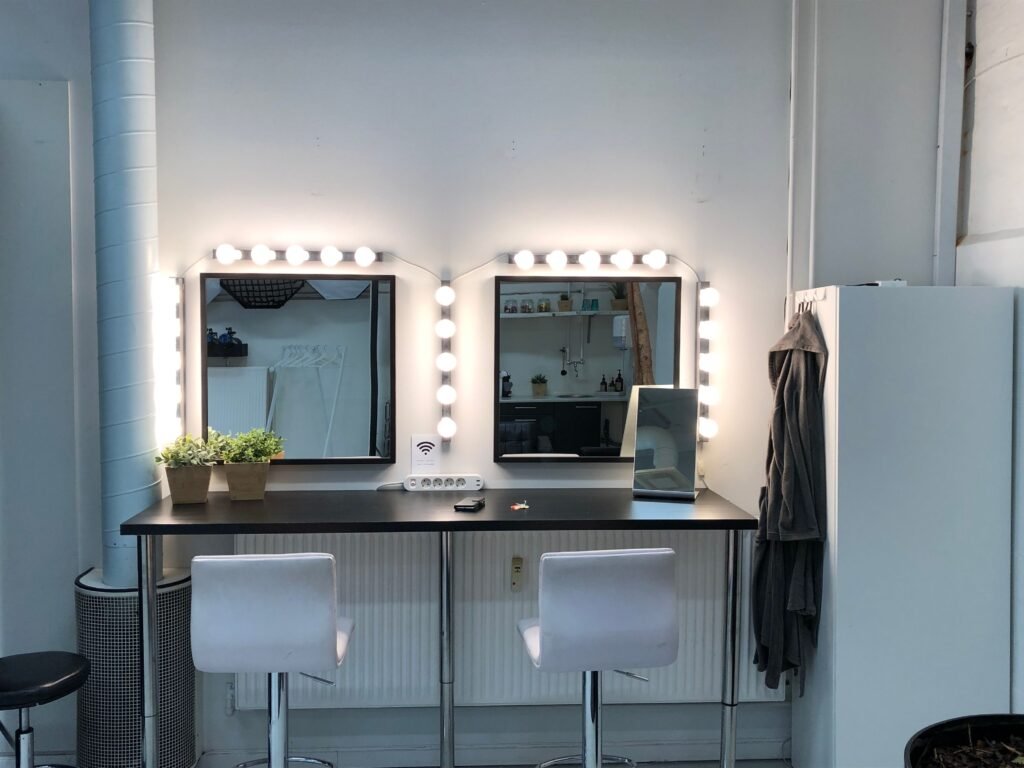
- Where the light comes from: the front, not just the ceiling. Light placed on both sides of the mirror at face level, or a mirror with diffused light around its edge, lights the face evenly. A single ceiling light creates shadows under the eyes and nose.
- Colour accuracy (CRI): look for a colour rendering index of 90 or higher. Lighting professionals recommend this where you make colour decisions about your own face, because low-CRI bulbs can make foundation and blush look different from how they appear in daylight.
- Colour temperature: many guides suggest roughly 3,000 to 4,000 K for makeup, which gives a neutral to warm white. Cooler light (5,000 K and above) looks like daylight but can feel harsh. Mirrors with adjustable settings let you check your look in both warm and cool light. Colour temperature is the setting where experts disagree, so choose what lets you see your skin truthfully.
- Brightness: even light is more important than very bright light. Some lighting guides suggest around 500 to 750 lux at the face for detailed makeup, with softer ambient light in the room so the mirror is not a bright island in a dark space. Look for a dimmable mirror rather than chasing a high number.
- Natural light: a spot facing a window is good for checking your finished look. Do not sit with your back to a bright window, as it puts your face in shadow.
- Heat and glare: LED lights run cooler than old incandescent bulbs, so your makeup is less likely to feel uncomfortable or melt under them. Matte walls and surfaces nearby reduce glare.
- Bathrooms: fixtures near sinks and showers should be rated for damp locations. Check your local wiring rules and use a licensed electrician for any fixed installation.
- Power cuts: in countries with frequent outages, choose a rechargeable LED mirror or keep a battery lamp nearby.
Makeup Vanity Ideas for Every Space
Small bedroom or apartment
A floating shelf-style vanity 30 to 40 cm (12 to 16 in) deep takes very little room. Hang the mirror directly on the wall and use wall shelves or a pegboard for brushes. A narrow console table or a desk with a lit mirror works too.
Shared room or studio flat
Choose a vanity desk that doubles as a workstation. Use a lidded organiser or a tray you can lift away, so the surface becomes a desk again when you are done.
Bathroom
If the bathroom is the only space, keep the counter simple: a good lit mirror, a stool that fits nearby, and a few daily items. Keep the rest of your products in a bedroom drawer, because steam and heat are bad for cosmetics (more on this below).
Walk-in closet or dressing room
Built-in vanities can have hidden sockets, drawer dividers and integrated lights. Plan the wiring and socket positions before the cabinets are made, and add a mirror that is at least shoulder width.
Hallway, living room or alcove
A slim console and a wall mirror in an alcove or beside a window can be a stylish, flexible spot. Add a wall light on each side or a mirror with its own lighting.
Corner or under-window spot
A small corner table with a tri-fold or swing-arm mirror makes use of space you would not otherwise use. Placing it beside a window gives you natural light, as long as the sun does not hit your products directly.
DIY makeup vanity
You can make a makeup vanity from an old desk, console table or chest of drawers. Sand and repaint it, add new handles, hang a mirror, and add a clip-on or plug-in LED light with a CRI of 90 or more. Anchor anything on the wall using fixings that suit your wall type.
Makeup Vanity Styles From Around the World
Styles change with climate, home sizes and local taste. The ideas below are general trends rather than strict rules.
- Minimalist and Japandi: clean lines, pale wood, a simple frameless mirror and hidden storage. This look suits small homes and is popular in many Asian cities where space is limited.
- Mediterranean: warm wood, wrought iron or marble, arched mirrors and natural textures. Pair with light linen and neutral tones.
- Middle Eastern and Gulf: many homes have larger dressing rooms and walk-in closets, so a built-in vanity with lots of drawers, a mirror wall and storage for perfumes and accessories is common. Gold or brass details and carved wood are popular.
- South Asian: dressing units are often built into wardrobes or placed against a bedroom wall, with a large mirror and drawers for jewellery, bangles and makeup. Compact designs and storage that closes completely help with dust.
- African and tropical: natural materials such as rattan, cane and treated hardwood, in light colours that suit warm rooms. Choose finishes that cope with humidity.
- Vintage and glam: ornate frames, tufted stools and tri-fold mirrors, borrowed from classic dressing-table design.
- Boho: rattan mirrors, woven baskets and layered textures. Use baskets with lids for dust and keep real plants away from damp products.
Makeup Vanity for Hot and Humid Climates
In hot, humid or coastal places, the room is as important as the furniture.
- Heat: the US Food and Drug Administration (FDA) warns that heat can make the preservatives in cosmetics break down, so bacteria and fungi can grow faster. Do not keep products in a hot car, on a sunny windowsill or near a heater.
- Humidity: steam and damp air speed up mould and spoilage. Place your makeup vanity in a bedroom or dressing room, not in a steamy bathroom, and use an air conditioner or dehumidifier if your home is very damp.
- Materials: choose sealed wood, laminates with sealed edges, or metal. Avoid bare MDF or particleboard, which swells in damp air.
- Dust: in dusty or dry regions, use drawers with lids, closed organisers and covered trays, and wipe the surface regularly.
- Coastal air: salt air can corrode cheap metal handles and hinges, so look for treated hardware.
- Power cuts and fluctuating voltage: use a surge-protected socket for lights, and consider rechargeable lights.
Makeup Vanity on Any Budget
The prices below are rough guides in US dollars and vary a lot by country, shipping and brand, so check local prices.
| Budget level | Rough range | What you can expect |
|---|---|---|
| DIY | Under about $100 | A repurposed desk or dresser, paint, a wall mirror, plug-in LED lights |
| Affordable | About $100 to $300 | Flat-pack vanity tables, tabletop lit mirrors, simple stools |
| Mid-range | About $300 to $1,000 | Solid wood or good-quality veneer, built-in lights, soft-close drawers |
| Custom and luxury | $1,000 and above | Built-in or made-to-order units, stone tops, integrated lighting |
Where to spend and where to save: spend on the mirror light, the stool or chair and sturdy construction. Save on decoration, since trays, plants and frames can be added any time.
How to Organize Your Makeup Vanity and Keep It Hygienic
Organizing
- Keep the top simple: only daily items, a brush holder and a small tray. A cluttered surface is slower to use and harder to clean.
- Use drawers for the rest: shallow drawers or dividers let products lie flat so you can see them. Group by type, such as face, eyes, lips and tools.
- Go vertical: wall shelves, a pegboard or a small riser use space above the table.
- Keep tools clean and separate: store brushes upright, bristles up, and sponges in a clean, ventilated container.
Hygiene
The FDA says eye-area cosmetics have a shorter shelf life than other products, and that manufacturers usually recommend discarding mascara two to four months after purchase. The agency also advises throwing mascara away if it dries out, keeping containers and applicators clean, and storing products away from heat. Bacteria can also spread from fingers, so wash your hands before applying makeup and do not share products or brushes.
The table below shows common replacement guidelines. They are general estimates, so follow the label (look for the open-jar symbol with a number of months) where it exists.
| Product | Common guideline after opening |
|---|---|
| Mascara and liquid eyeliner | About 3 months (FDA: 2 to 4 months for mascara) |
| Liquid foundation and concealer | About 6 to 12 months |
| Lipstick and lip gloss | About 1 year |
| Powder products (blush, eyeshadow, face powder) | Up to about 2 years |
| Anything with a changed smell, colour or texture | Throw away |
If you have an eye infection, replace your eye makeup and brushes afterwards, since they may carry the bacteria.
Safety, Power Sockets and Accessibility
Electrical safety
- Check voltage and plugs: most of the world uses about 220 to 240 V, while the US, Canada and parts of Latin America use about 120 V and Japan about 100 V. Plug shapes also differ by country. Always check the label on a mirror or light and buy the version made for your country, or use an approved adaptor.
- Keep cords away from water, and avoid chaining several extension leads together.
- Use damp-rated lights near sinks and showers, and use a licensed electrician for hardwired lights and new sockets, following your local rules.
Wall-mounted units
A floating vanity must carry the weight of the table, products and leaning arms. Use fixings that match your wall: masonry anchors for brick or concrete, and proper anchors or studs for plasterboard. If you are unsure, ask a professional installer.
Accessibility
A makeup vanity should work for everyone, including wheelchair users and people who find it hard to bend or reach. Leave open knee space under the table, use a stool or chair that is easy to get on and off, and keep everyday products within easy reach. US accessibility guidelines call for knee clearance of at least about 27 in (69 cm) high under a work surface, so you can use that as a starting point, but check the standard that applies in your country.
Homes with children or pets
Secure tall mirrors and wall units so they cannot tip or fall, keep glass and small items out of reach, and store perfumes and nail products where children cannot reach them.
Common Makeup Vanity Mistakes to Avoid
- Relying on ceiling light only, which creates shadows on the face.
- Choosing low-CRI or very cool bulbs, so makeup looks different in daylight.
- Buying a table that is too deep or too high for your seat, or a stool that does not tuck in.
- Putting the makeup vanity in the bathroom and keeping all products there, where steam and heat shorten their life.
- Using unsealed MDF in a humid home.
- Skipping a mirror at the right height, so you have to lean or tilt.
- Overloading the top with decor, which leaves no room to work.
- Ignoring sockets and cables, leading to extension-lead tangles near water.
- Never checking expiry or cleaning, which leads to old products and dirty brushes.
Frequently Asked Questions About Makeup Vanity Setups
What do you need for a makeup vanity?
The essentials are a table or desk at a comfortable height, a mirror, even lighting, a seat and storage. Optional extras include a brush holder, a tray for daily products, a jewellery stand and a perfume tray.
How big should a makeup vanity be?
A slim makeup vanity can be as small as 80 cm (31 in) wide and 35 to 40 cm (14 to 16 in) deep. A comfortable one is 100 to 120 cm (39 to 47 in) wide and 45 to 50 cm (18 to 20 in) deep. Leave 75 to 90 cm (30 to 36 in) behind the seat.
What is the best lighting for a makeup vanity?
Light from both sides of the mirror at face level, CRI 90 or higher, a neutral to warm white (roughly 3,000 to 4,000 K), and dimmable settings. Avoid relying only on a ceiling light.
Can a makeup vanity go in the bathroom?
Yes, but be careful. Use damp-rated lights and moisture-resistant furniture, and keep most of your products in a drier, cooler room, because steam and heat speed up spoilage.
What is the difference between a makeup vanity and a dressing table?
In everyday use there is little difference. Both are tables with a mirror and storage for dressing and makeup. Some shops use dressing table for traditional designs and makeup vanity for modern lit versions.
How do I make a makeup vanity in a small space?
Use a wall-mounted or slim console vanity 30 to 40 cm deep, hang the mirror on the wall, add wall shelves and use a lit mirror instead of separate lamps. A desk that doubles as a vanity also works.
How do I keep makeup clean and safe on a vanity?
Store it away from heat, steam and direct sun, keep lids closed, wash your hands before use, clean brushes regularly and replace products according to their labels. Eye products need replacing most often.
Is a makeup vanity worth it?
If you do makeup regularly, a dedicated spot with proper light, a seat and storage makes it quicker, more accurate and easier to keep products organised. It does not have to be expensive: a good lit mirror and a stable table are enough.
The Bottom Line
A good makeup vanity is a matter of fit rather than fashion. Measure your space, choose a table and seat that suit your height, light your face from both sides with high-CRI bulbs, and keep your products cool, dry and clean. Adapt the style to your culture and climate, and check electrical and wall-fixing details for your country. Start with one simple setup, such as a stable table, a lit mirror and a tidy drawer, and improve it over time.